
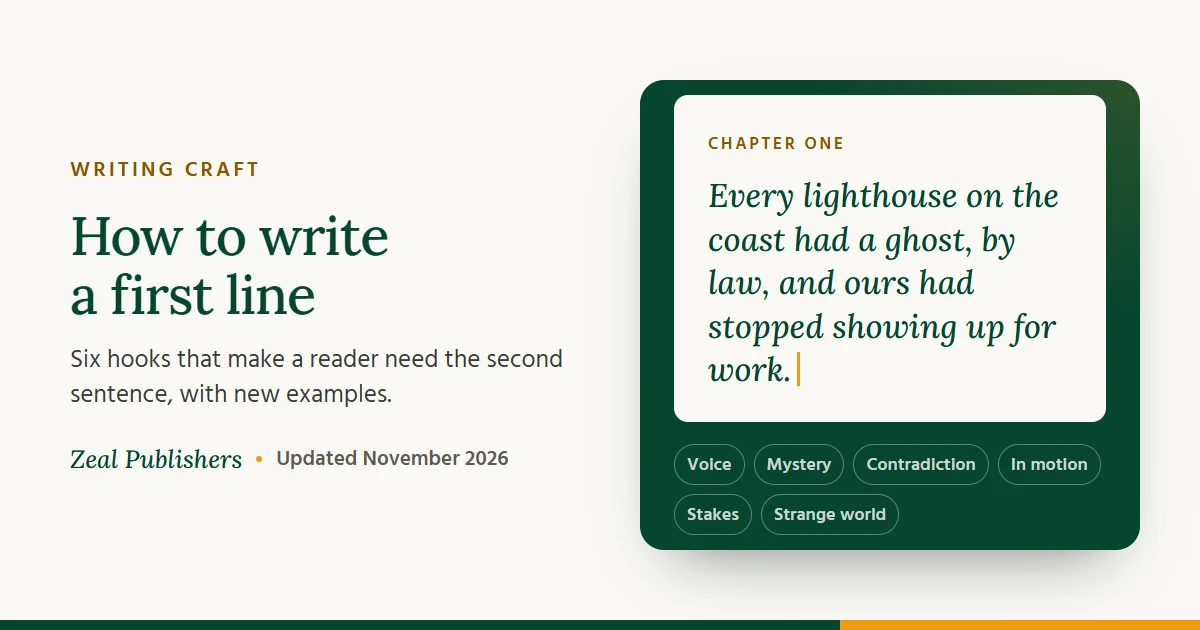
A good first line makes the reader need the second one. It usually does that with one of six hooks: a voice worth listening to, a question only the book can answer, a contradiction, a story already in motion, something at stake, or a world with one strange rule. Write the first line early if it helps you start, but rewrite it last, when you know what the rest of the book promises.
This guide takes each hook in turn, with an example line written for this article (none are from real books, and none are from our First Line puzzle, so the game stays fresh). Then it shows two flat openings revised, covers nonfiction and memoir, and lists the openings editors most often cut.
What a first line actually has to do
A first line isn't a summary, and it isn't a thesis. It's a promise about the kind of attention the book will reward. In one sentence, the reader learns how the book sounds, roughly what kind of book it is, and whether something is happening that they'll want to follow.
That's why a first line can't be judged alone. A quiet, careful sentence is the right opening for a quiet, careful novel. A breathless one is wrong for it, however clever. The best first lines aren't the loudest; they're the ones that set up exactly the book that follows.
What every good opening shares is a gap: something the reader knows they don't yet know. The six hooks below are six ways of opening that gap.
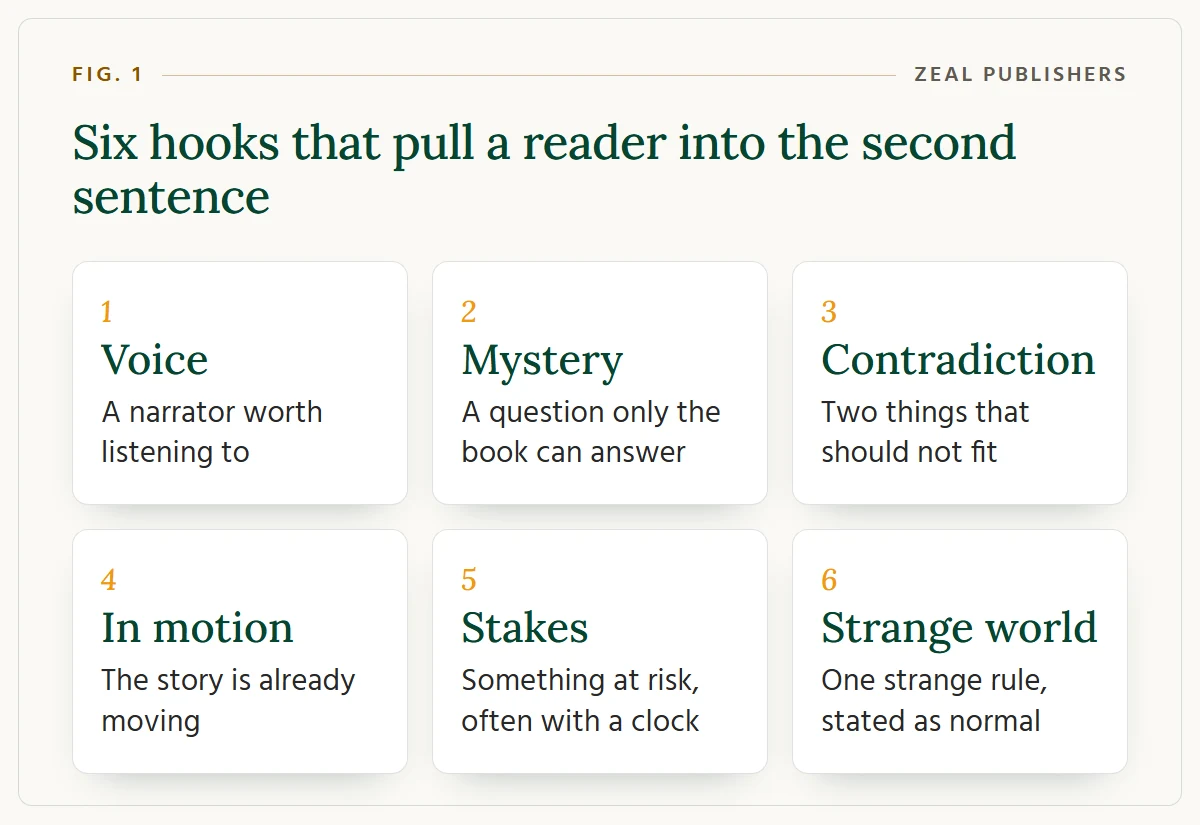
The six hooks, with new examples
1. Voice
A narrator so distinct that you want to keep listening, whatever they talk about.
I have been fired from four jobs, and I would like to say up front that two of them were my fault.
Nothing has happened yet, and the reader is already hooked on the person. The sentence has a rhythm (four jobs, then the careful concession), an attitude (honest, a little defensive) and a joke that only works because it's delivered straight. Voice openings live or die on the second sentence keeping the same voice.
The trap: quirkiness instead of character. A voice hook works when the voice reveals who someone is, not when it performs.
2. Mystery
A question planted in the first sentence that only the book can answer.
The moving company returned every box but one, and the one they kept was the box I had never packed.
The reader now has a question they can't put down: whose box, and how did it get into the move? A good mystery line is specific. "Something was wrong" plants nothing; one concrete impossible detail plants everything.
The trap: withholding for its own sake. The question has to be one the book genuinely answers, and soon enough that the reader trusts you.
3. Contradiction
Two things side by side that should not fit, so the reader needs to know how they do.
The safest man in Harlow County was the one who'd confessed to all three fires.
Safe and arsonist don't belong in the same sentence, so the reader's mind starts building the story that reconciles them. Contradiction is efficient: it raises a question and establishes a world with irony in it, in one line.
The trap: contradictions that are merely odd. The two halves should pull against each other in a way the book is actually about.
4. In motion
The story is already moving when the book begins, and the reader has to catch up.
Dana took the stairwell two steps at a time, and somewhere between the fourth floor and the third, the alarm stopped.
The reader arrives mid-action and has to run to keep up. And the twist at the end (the alarm stopping is worse than the alarm) shows that the motion is going somewhere. Motion openings work best when the reader understands enough of the action to feel it without needing the backstory yet.
The trap: confusion. Starting in motion isn't the same as starting in chaos. One clear action beats three blurry ones.
5. Stakes
Something that matters, at risk, often with a clock running.
If the dam inspector found the crack before Friday, Mira would lose her license; if he didn't, the valley might lose a lot more.
The line sets up a dilemma with a deadline, and both outcomes are bad. Stakes openings are strong because they tell the reader what to worry about. The best ones make the stakes personal and larger at the same time, as this one does.
The trap: stakes too big to feel. "The fate of the world" is abstract; one person's license, and a valley below a dam, are not.
6. Strange world
One unfamiliar rule, stated as normal, that tells you this world is not ours.
On the island, every child was given a lie on their seventh birthday, and was expected to keep it for life.
The power is in the flat, matter-of-fact delivery. The narrator doesn't explain the rule or marvel at it, so the reader understands that here, this is ordinary. One rule is enough; the reader will infer a whole society from it.
The trap: world-building instead of storytelling. Three invented terms in the first line is a glossary, not a hook.
When two hooks work together
Some of the strongest openings combine two hooks, one carrying the other. Here's a strange world and a mystery in the same line:
Every lighthouse on the coast had a ghost, by law, and ours had stopped showing up for work.
The first half sets the rule (ghosts are ordinary, even required). The second half breaks it, and the broken rule is the question. Neither half would hold the reader as well alone.
Combinations work when one hook leads and the other supports. Voice pairs naturally with anything, because voice is how the line is told rather than what it says. Stakes and motion pair well too: a story already moving, toward something that matters. What rarely works is three or four hooks crammed into one sentence. The line gets long, and the reader can't tell which question to hold.
Two flat openings, revised
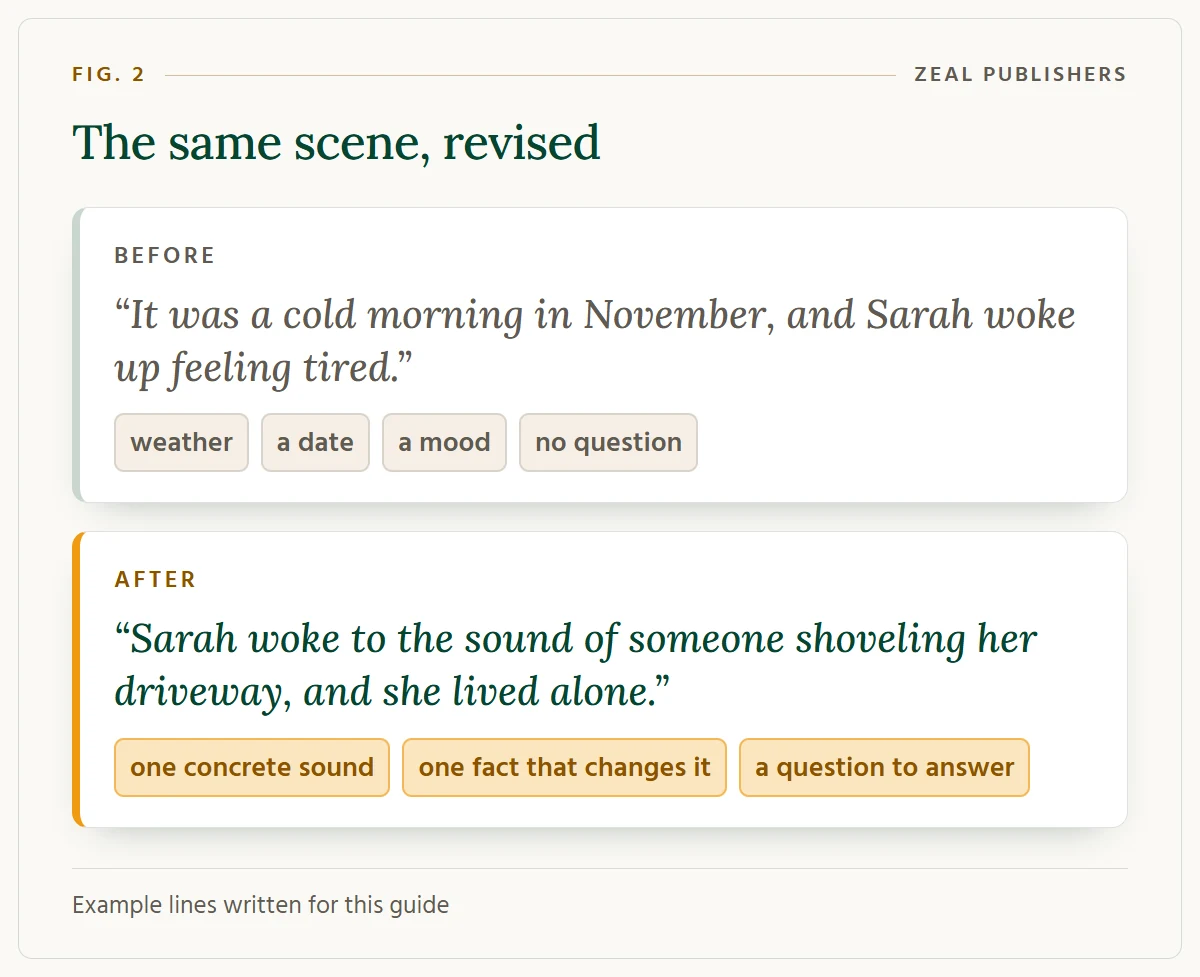
Most first drafts open with a sentence that is perfectly correct and does nothing. Here are two, written for this article, and what an editor would do with each.
Fiction.
- Before: "It was a cold morning in November, and Sarah woke up feeling tired."
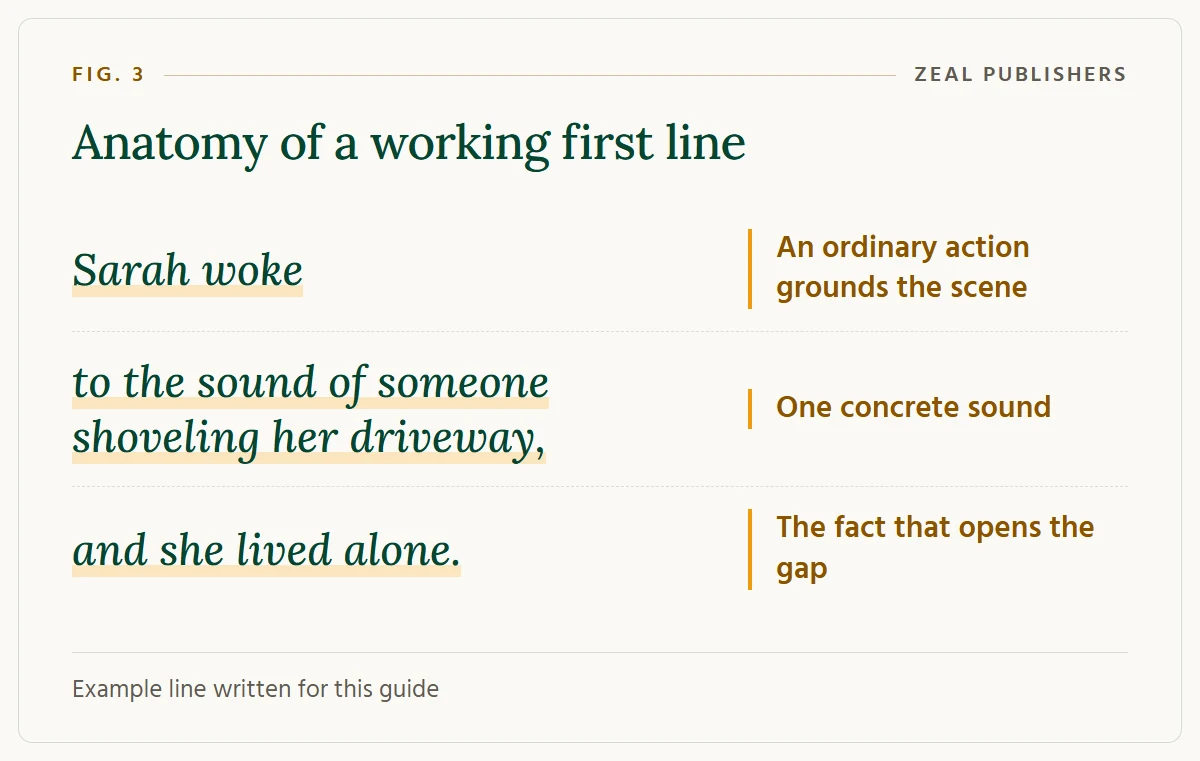
- After: "Sarah woke to the sound of someone shoveling her driveway, and she lived alone."
The first version offers weather, a date and a mood, and no gap. The revision keeps the morning and the cold (the snow is implied), but adds one detail that makes the ordinary sound frightening. It's a mystery hook built from the same scene.
Nonfiction.
- Before: "This book is about the lessons I learned in twenty years of leading teams."
- After: "The most useful thing I ever said to a team was 'I don't know,' and it took me eleven years to say it."
The first version describes the book instead of starting it. The revision gives the reader a specific claim, a little surprise and a voice, and it promises the book's subject (leadership) without announcing it.
First lines for nonfiction and memoir
Everything above applies to nonfiction, with one adjustment: the hook usually comes from a scene, a claim or a confession rather than a plot. Strong nonfiction openings tend to do one of these:
- Open on a scene. A specific moment, told like fiction: a room, a decision, a phone call. The argument comes after the reader is invested.
- Open on a claim that cuts against expectation. A sentence the reader disagrees with, or didn't expect from you, so they read on to see you defend it.
- Open on a confession. A memoir's natural hook is voice plus stakes: something you did, or that happened to you, told with honesty about what it cost.
What nonfiction should avoid is the windup: the definition, the history of the topic, the explanation of why the book exists. All of that can come later, once the reader cares.
The openings editors cut most often
Some first lines fail so reliably that editors cut them on sight. Not because the rules forbid them, but because they rarely open a gap:
- Waking up. The character opens their eyes, and the reader closes theirs.
- The weather, unless the weather is the story.
- A dictionary definition. "Webster's defines leadership as..." tells the reader you couldn't find a better way in.
- A rhetorical question. "Have you ever wondered...?" asks the reader to do the work you should be doing.
- Throat-clearing. "This is a story about..." or "In this book, I will..." announces instead of beginning.
- A crowd of names. Four characters in the first line means the reader remembers none of them.
How to find your first line
A first line is rarely written; it's found. A method that works for many writers:
- Finish the draft first. You can't know what the book promises until you know what it delivers.
- Write ten versions. Try at least three different hooks. The one you'd never have tried often turns out to be right.
- Read each one aloud, followed by your current second sentence. A first line that's brilliant alone but jars against the second has to go.
- Check it against your last line. The best openings and endings rhyme in some way: an image, a phrase, a question answered.
- Test the promise. Ask whether the book keeps the promise the line makes. A thriller opening on a comic novel is a broken promise, however good the line.
Then put the line in front of someone who hasn't read the book and ask one question: do you want to read the next sentence? That's the whole test.
The opening page matters as much as the opening line, and it's a good place to start revising. Our self-editing checklist covers what to fix, in the order editors fix it, and our guide to the signs a manuscript isn't ready covers the bigger questions.
Train your ear with First Line
The fastest way to feel how a first line works is to build one. First Line is our free daily puzzle: each day, the opening line of an invented book arrives as loose type, and you set it back in order. Pull a proof to check your setting; you have six proofs to get it right. Then an editor's note explains which hook the line uses and why it works.
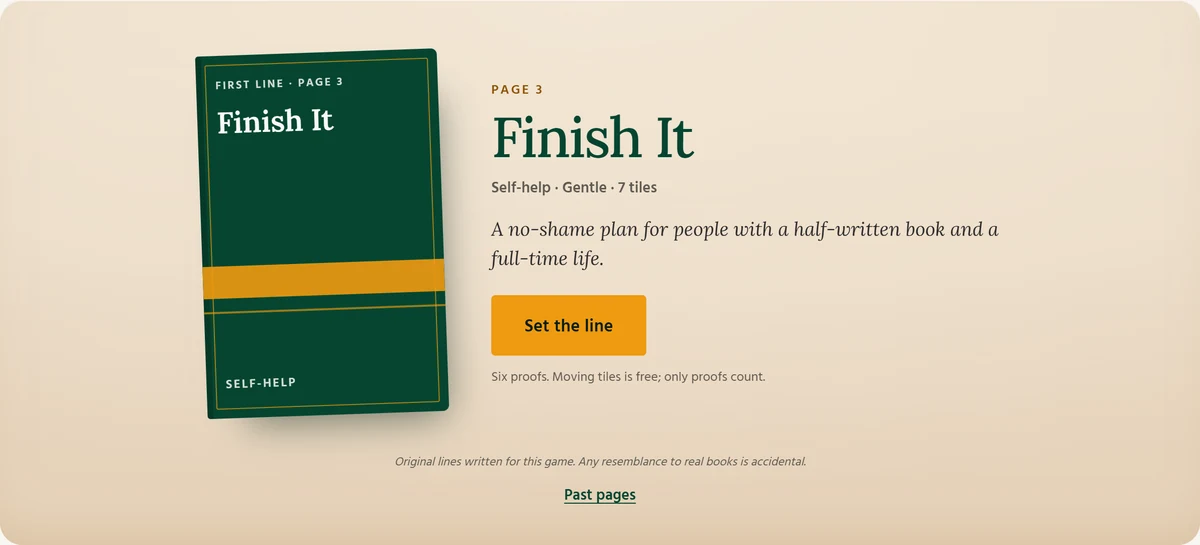
A new line arrives every day, there's no sign-up, and over a few weeks you'll have set lines built on all six hooks.
When it's your own opening you want looked at, paste your first pages into our free First 10 Pages Review for an instant editorial read: what hooks, what slows the reader down, and what to fix first. If you want a professional pass on the whole manuscript, our editing and proofreading service covers everything from structure to the final comma.
Frequently asked questions
What makes a good first line?
A good first line makes the reader need the second one. It opens a gap with one hook (a distinct voice, a mystery, a contradiction, a story in motion, clear stakes, or a strange world) and it fits the book that follows.
How long should the first line of a novel be?
As long as it needs to be and no longer. Short lines land hard; longer ones can build a voice or a situation. What matters is that every word earns its place, and that the line reads well aloud.
Should a novel start with dialogue?
It can, if the line of dialogue opens a gap on its own. Dialogue openings are hard because the reader doesn't yet know who's speaking or why it matters, so the line has to carry that by itself.
Should I write the first line first or last?
Write a placeholder first, so you can start, and rewrite it last, when you know what the book promises. Most strong first lines are found in revision.
How do I start a nonfiction book?
With a scene, a surprising claim or a confession, not with a definition or an explanation of what the book will cover. Get the reader invested first; the framework can follow in the next pages.
How Zeal helps authors
- Self-Publishing
- Ghostwriting
- Book Editing
- Cover Design
- Audiobook Production
- Book Marketing
- Memoir Writing
- Costs & Answers
- Free AI Tools
Publishing by book type
Ready to make your book real?
We write, publish & market it for you. You keep 100% of your rights.
Talk to a Publisher →or call +1 (609) 493-4557 · Play First Line · Authors Circle · All pages