
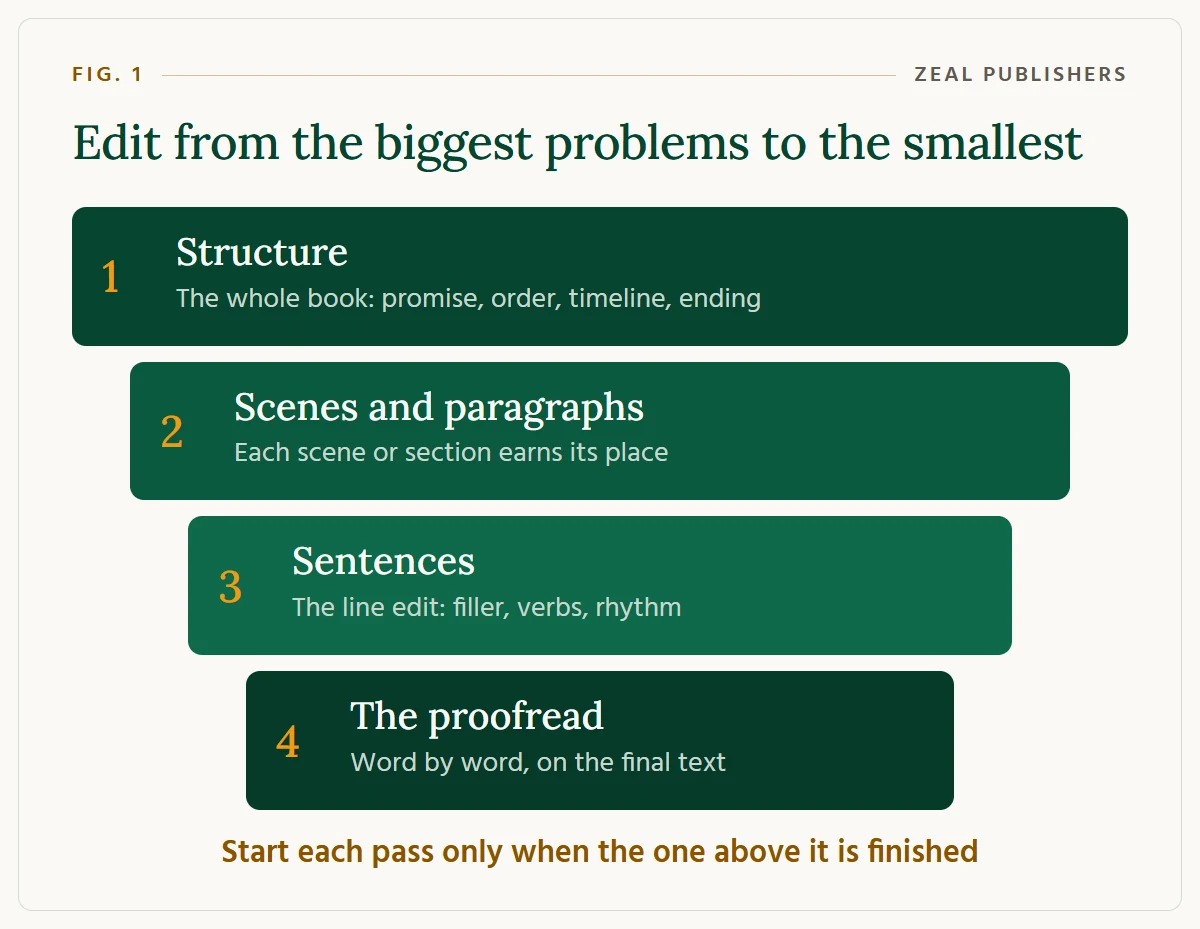
Self-edit your book in four passes, from the biggest problems to the smallest: structure first, then scenes and paragraphs, then sentences, then the proofread. Order is the whole trick. Polishing the commas in a chapter you later cut is wasted work, and a proofread done before the line edit misses the new errors the line edit introduces. Below is a checklist for each pass, the Chicago style conventions most American books follow, and the errors that survive even careful self-editing.
This is the order professional editors work in, too. A developmental edit comes before a line edit, and a proofread comes last. Our guide to developmental editing, copyediting and proofreading explains each one. Here, the aim is to do as much of that work as you can yourself, in the right order.
Before you start: get some distance
You can't edit a draft you still remember writing. Your eye reads what you meant, not what's on the page. Put the finished draft away for at least a few weeks if you can, and work on something else. When you come back, read the whole thing through once without changing anything, and make notes only on what you notice as a reader.
Then make a copy. Do each pass on a new version of the file, so you can always go back.
Pass 1: Structure
Read the whole book quickly, as a reader would, and ask only big questions. Don't fix sentences yet; you'll rewrite many of them.
- The promise. Does the first chapter promise the book you actually wrote? If the opening sets up a mystery and the book turns into a family saga, one of them has to change.
- Every chapter earns its place. For each chapter, write one line: what changes because of it. Any chapter where nothing changes is a candidate to cut or merge.
- The order. Are events or ideas in the order a reader needs them? In nonfiction, does each chapter rely only on what came before?
- The timeline. Do dates, ages and seasons add up? Make a simple list of events with dates and check it against the text.
- Point of view. Is it consistent, and when it changes, is that deliberate and clear?
- The ending. Does it resolve what the beginning set up? In nonfiction, does the last chapter deliver what the introduction promised?
- The reader's questions. Where would a reader be confused, bored or skeptical? Mark those places; they're often where the next pass starts.
If this pass turns up a big problem, fix it before going on. That might mean rewriting whole chapters, and it's far cheaper to do now than after you've polished every sentence.
Pass 2: Scenes and paragraphs
Now go chapter by chapter, and look at the units inside: scenes in fiction, sections and arguments in nonfiction.
- Each scene or section does a job. It moves the plot, reveals a character, or advances the argument. If it does none of those, cut it, however good the writing.
- Chapter openings and endings. Does each chapter start close to the action and end with a reason to turn the page? Chapters that end with a character going to bed often end too late.
- Repeated beats. Is the same thing happening twice, such as two arguments that make the same point, or two scenes where a character learns the same lesson? Keep the stronger one.
- Information dumps. Long passages of background stop the story. Cut them back to what the reader needs now, and move the rest later or out.
- Paragraph length. Very long paragraphs hide good ideas; strings of one-line paragraphs lose their force. Vary them.
- Dialogue that only delivers facts. Characters telling each other things they both already know is a sign the information belongs somewhere else.
Pass 3: Sentences
This is the line edit: the pass that makes the prose read well. Work through it slowly, a few pages at a sitting.
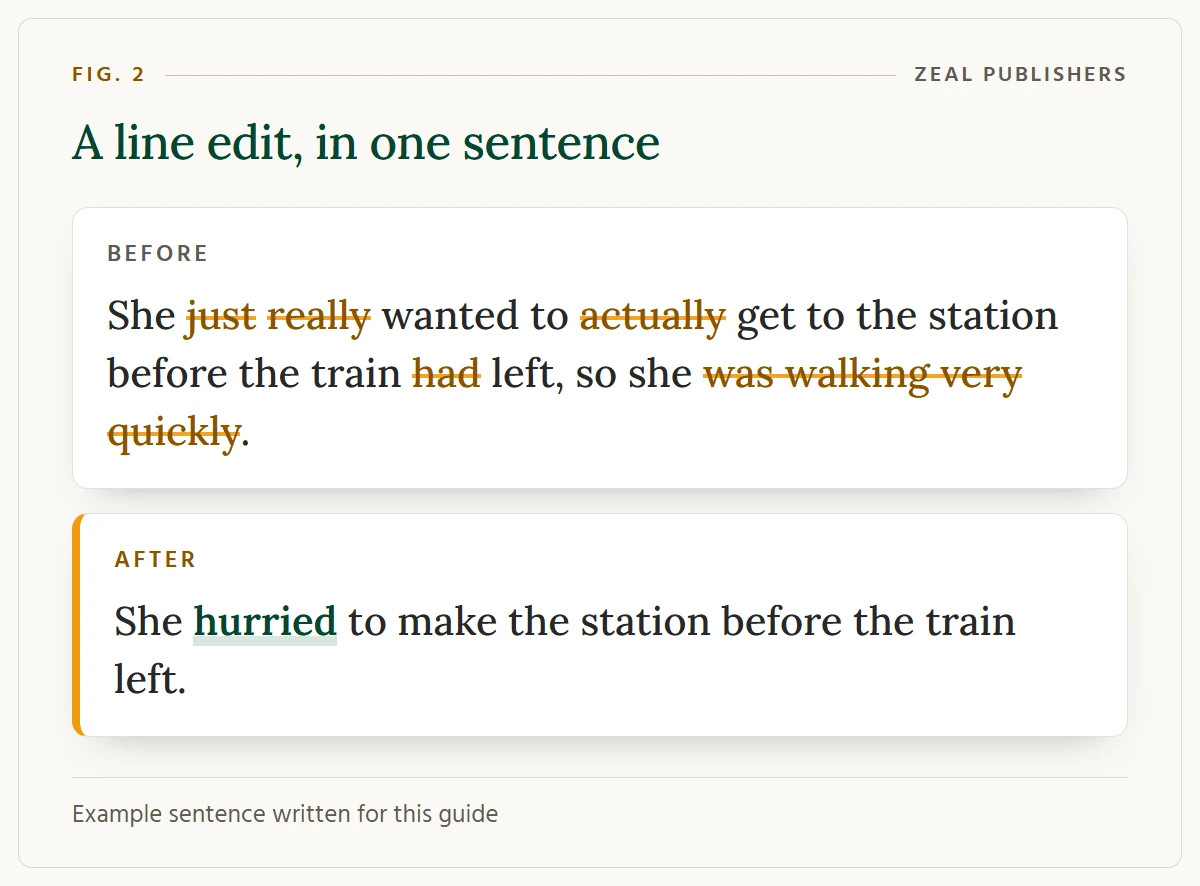
- Cut filler. Words like just, really, very, actually, quite and that (when it's not needed) usually add nothing. Search for each one and keep it only where it earns its place.
- Strengthen verbs. "She walked quickly" is weaker than "she hurried." Look hard at was, were, had and got followed by another verb.
- Spot your own habits. Every writer repeats certain words and constructions. Find yours (a favorite adjective, a sentence shape, a gesture characters keep making) and vary them.
- Check dialogue tags. Said is almost invisible, which is its strength. Tags like exclaimed, retorted and opined draw attention to themselves.
- Clarify. Any sentence you have to read twice, the reader will too. Split it or rewrite it.
- Read it aloud. Rhythm problems you can't see, you can hear.
Pass 4: The proofread
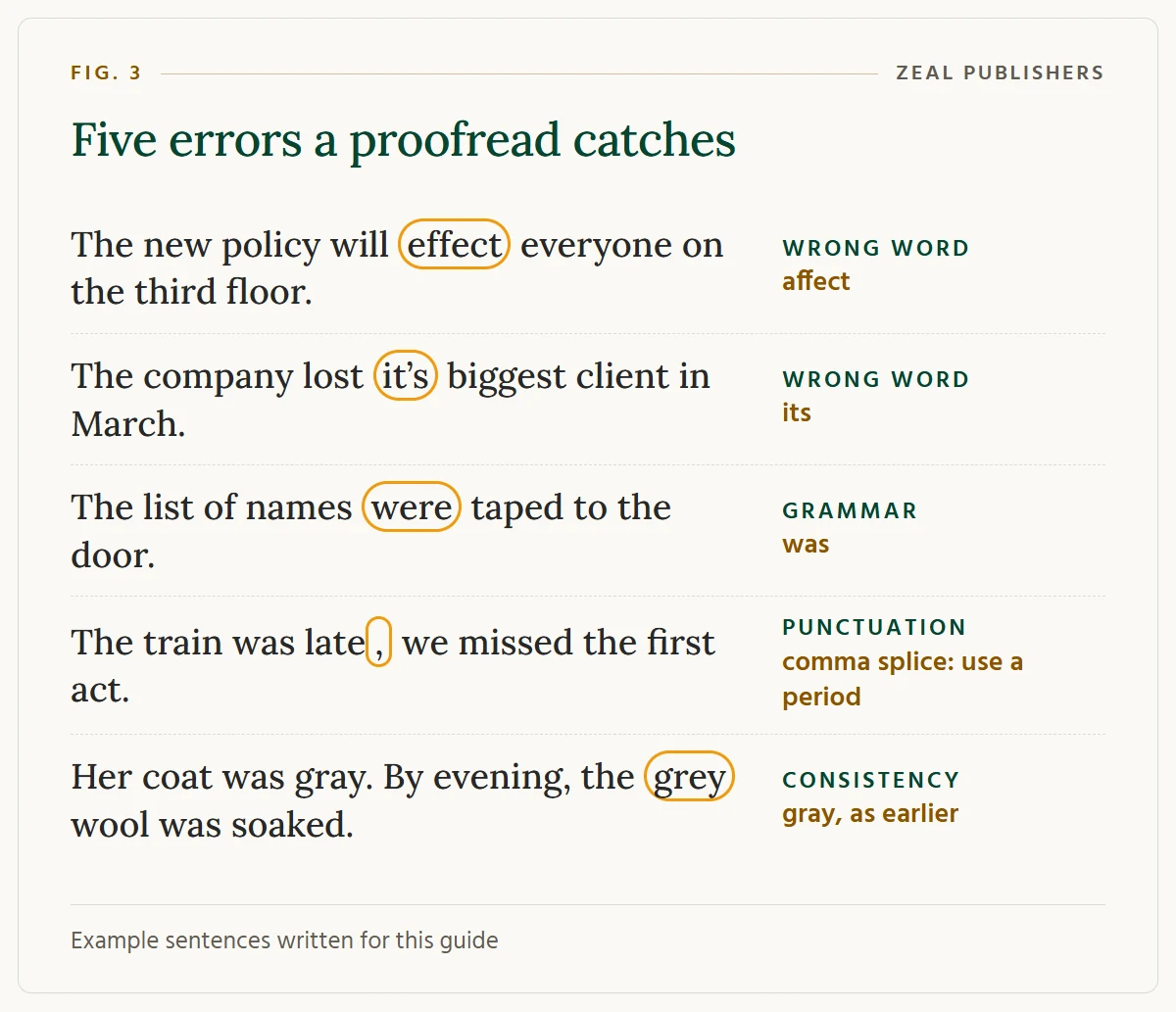
The proofread is the last pass, done on the final text, word by word. It looks for five kinds of error, the same five that a professional proofreader marks.
Spelling. Spell-checkers catch most typos but miss real words in the wrong place. Watch for names spelled two ways, and for words that are correct but not the ones you meant.
Grammar. The errors that hide are the ones where the sentence still sounds right:
- "The list of names were taped to the door." The subject is list, so: was.
- "Running for the bus, my phone fell out of my pocket." The phone wasn't running. Rewrite it: "As I ran for the bus, my phone fell out of my pocket."
Punctuation.
- "The train was late, we missed the first act." Two sentences joined by a comma is a comma splice. Use a period or a semicolon.
- "'I'll wait outside', she said." In American style, the comma goes inside the quotation marks: "'I'll wait outside,' she said."
Wrong words. The homophones and near-misses spell-check can't see:
- "The new policy will effect everyone on the third floor." The verb is affect.
- "The company lost it's biggest client in March." It's means "it is." The possessive is its.
- "They walked passed the bakery twice." The word is past.
Consistency. The errors that only show across pages: a character's eyes that change color, gray in one chapter and grey in another, Ms. Okafor on page 40 and Mrs. Okafor on page 112, a town that's two hours away and then four.
The Chicago style conventions to apply
Most American trade books follow The Chicago Manual of Style. You don't need to own it to self-edit well; you need to apply a handful of its conventions consistently:
| Convention | Chicago style | Example |
|---|---|---|
| Serial comma | Use it | red, white, and blue |
| Numbers in running text | Spell out zero through one hundred | forty-two guests; 342 guests |
| A number that starts a sentence | Spell it out | Twelve people came. |
| Percentages | Numeral plus the word percent | 45 percent |
| Em dash | Closed up, no spaces | She knew—everyone knew. |
| En dash | For ranges of numbers | pages 45–52 |
| Periods and commas with quotation marks | Inside the closing mark | "It's late," he said. |
| Possessive of a name ending in s | Add 's | James's book |
| Times of day | Lowercase, with periods | 7:30 a.m. |
| Titles and headings | Headline-style capitals | The Long Way Home |
The rule that matters more than any single convention is consistency. A reader won't notice whether you use the serial comma, but they'll notice when you use it on page 10 and drop it on page 11.
Keep a style sheet
Professional copyeditors keep a style sheet for every book, and you should too. It's a simple document listing every decision you make as you edit:
- Names and places, spelled exactly as they appear, with any details that must stay consistent (ages, eye colors, distances).
- Spelling choices, such as gray or grey, toward or towards (American usage favors toward), and OK or okay.
- Hyphenation, such as email or e-mail, and compound words you've had to decide on.
- Numbers, and any exceptions to the spelling-out rule.
- Capitalization of terms special to your book.
When you're unsure on page 200, the style sheet tells you what you decided on page 20. If you later hire an editor, it's the first thing they'll want.
Tricks that make your own errors visible
The hardest part of self-editing is that your brain autocorrects your own work. These tricks interrupt it:
- Change how the text looks. A different font, size or column width makes familiar text look new, and errors jump out.
- Print it. Many writers catch things on paper that they miss on screen.
- Read it aloud, or have your computer read it to you. Your ear catches missing words and clumsy rhythm.
- Hunt one error type at a time. One pass for its and it's, one for dialogue punctuation, one for your filler words. Searching the file for each is faster than reading for all of them at once.
- Read the last pages first. Errors cluster where you were tired. The final chapters usually get the least attention in every draft.
The last check: everything that isn't the story
Once the text is final, one more short pass catches the errors that live outside the chapters. They're easy to miss because nobody reads these pages the way they read the book, until a reviewer does.
- The table of contents matches the chapter titles and numbers exactly.
- Running heads and page numbers are right on every page, and missing where they should be (chapter openings, blank pages).
- Chapter titles and numbering follow one style throughout.
- The copyright page has the right year, edition and ISBN for each format.
- The dedication, acknowledgments and author bio have been proofread too. Names of real people in the acknowledgments deserve a second check.
- The back cover copy and book description are proofread with the same care as chapter one. They're the first words most buyers read.
- Cross-references ("see chapter 4") still point to the right place after any restructuring.
If you're formatting the book yourself, our guide to common KDP formatting mistakes covers what goes wrong between a clean manuscript and a clean printed page.
What self-editing can't do
Self-editing will make your book cleaner, clearer and stronger, and it will make any professional editing that follows faster and cheaper. But it has a limit: you can't fully see your own blind spots. You know what you meant, so you read it on the page even when it isn't there. That's true of every writer, including professional ones, which is why their books have editors too.
If you're going to publish, a fresh, trained pair of eyes on the final text is worth it. Our editing and proofreading service covers developmental editing, copyediting and proofreading, by experienced editors matched to your genre. If you want to start smaller, paste your opening pages into our free First 10 Pages Review for an instant editorial read. And if you're still working on how the book opens, our guide to writing a first line covers the most important sentence in the manuscript.
Sharpen your eye with The Red Pen
Proofreading is a skill, and it improves with practice. The Red Pen is our free daily proofreading game: one original manuscript page a day, the same page for everyone, with five hidden mistakes. Circle them, pick the right fix, and see how sharp your editor's eye is, with eight drops of ink to spend.
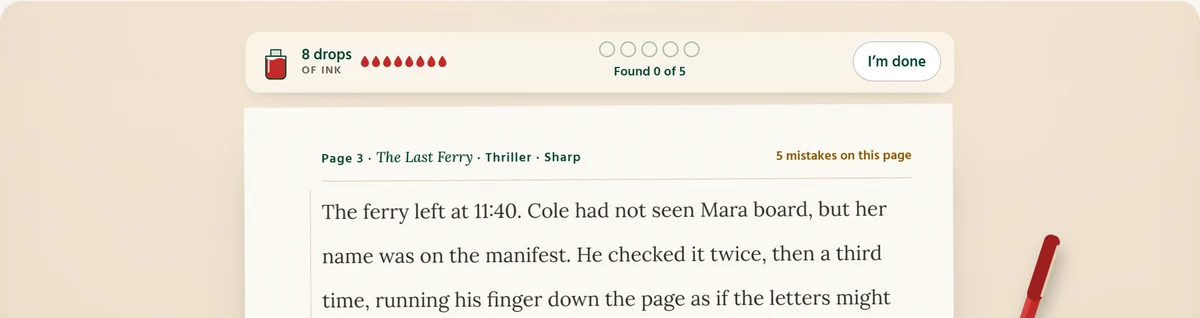
Its mistakes fall into the same five categories as the proofread above: spelling, grammar, punctuation, wrong words and consistency. A few minutes a day is a good habit for any writer heading into a final pass.
Frequently asked questions
How do I self-edit my book?
In four passes, from big to small: structure (the whole book), scenes and paragraphs, sentences (the line edit), and finally the proofread. Take time away from the draft first, and do each pass only after the one before it is finished.
What is the difference between editing and proofreading?
Editing improves the book: its structure, its scenes and its sentences. Proofreading is the final check of the finished text for errors in spelling, grammar, punctuation, word choice and consistency. Proofreading always comes last.
How many times should I edit my book?
At least once in each of the four passes, and often more than once for structure. Most books need several drafts before the proofread, and a proofread should be done on the final text, after all other changes.
Does Chicago style use the Oxford comma?
Yes. The Chicago Manual of Style uses the serial (Oxford) comma: red, white, and blue. Whatever you choose, use it consistently throughout the book.
Do I still need an editor if I self-edit?
If you're publishing, a professional editor is worth it, because no writer can fully see their own blind spots. Self-editing first makes professional editing faster and less expensive, because the editor can spend their time on what only a fresh reader can catch.
How Zeal helps authors
- Self-Publishing
- Ghostwriting
- Book Editing
- Cover Design
- Audiobook Production
- Book Marketing
- Memoir Writing
- Costs & Answers
- Free AI Tools
Publishing by book type
Ready to make your book real?
We write, publish & market it for you. You keep 100% of your rights.
Talk to a Publisher →or call +1 (609) 493-4557 · Play The Red Pen · Authors Circle · All pages