
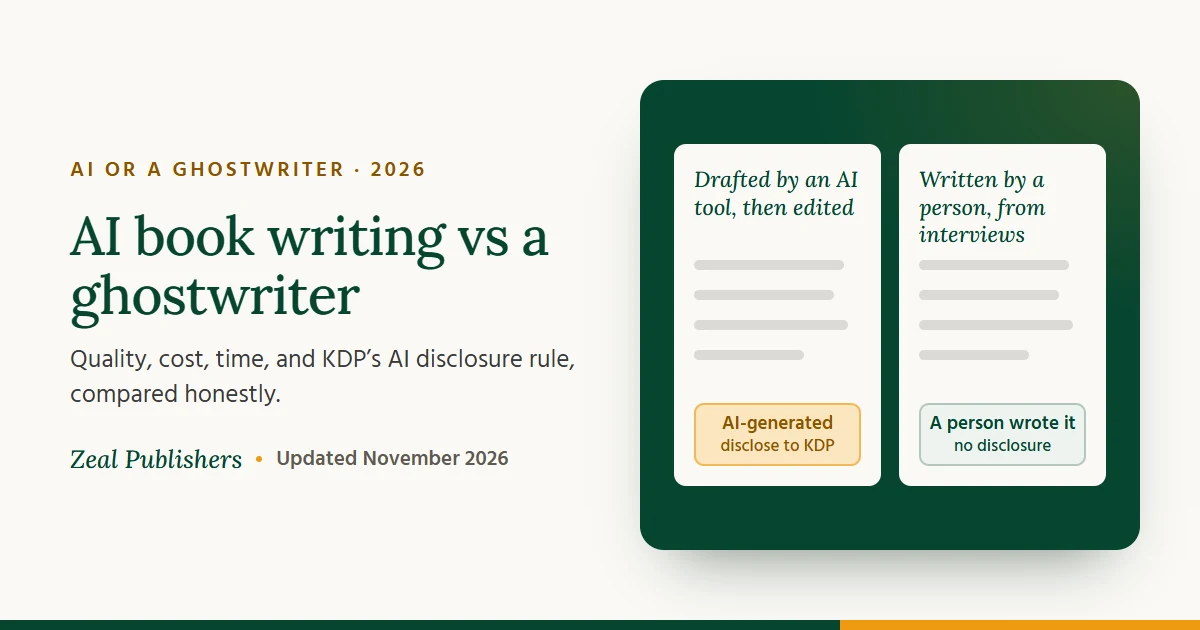
Short version: AI is a useful writing assistant and a poor author, and in 2026 the difference has a label. AI can draft a book in hours for the price of a subscription, but under Amazon KDP's rules, text an AI tool drafted is "AI-generated" and must be disclosed, "even if you applied substantial edits afterwards." A ghostwriter interviews you and writes the book fresh, in your voice, so the text is written by a person. Use AI if you'll write the book yourself and want help along the way. Hire a ghostwriter if the book carries your name and reputation and you don't have the time to write it.
Here's the honest comparison, without the hype in either direction, updated for the rules that now apply when you publish. As of November 2026: the KDP and US Copyright Office rules below are quoted from their own pages, as read on November 2, 2026.
What changed: publishing now asks how the book was written
When this guide was first written, the AI-or-ghostwriter question was about quality and cost. It still is, but there's now a third question that decides as much: what you'll have to tell the platform you publish on.
Amazon KDP's Content Guidelines require it in one sentence:
We require you to inform us of AI-generated content (text, images, or translations) when you publish a new book or make edits to and republish an existing book through KDP.
And they define the label by where the content came from, not how polished it is:
If you used an AI-based tool to create the actual content (whether text, images, or translations), it is considered "AI-generated," even if you applied substantial edits afterwards.
Content you created yourself, where AI only helped you "edit, refine, error-check, or otherwise improve" it, or helped you "brainstorm and generate ideas," is AI-assisted, and KDP says, "You are not required to disclose AI-assisted content." Source: KDP Help, Content Guidelines: Artificial intelligence (AI) content, as of November 2026.
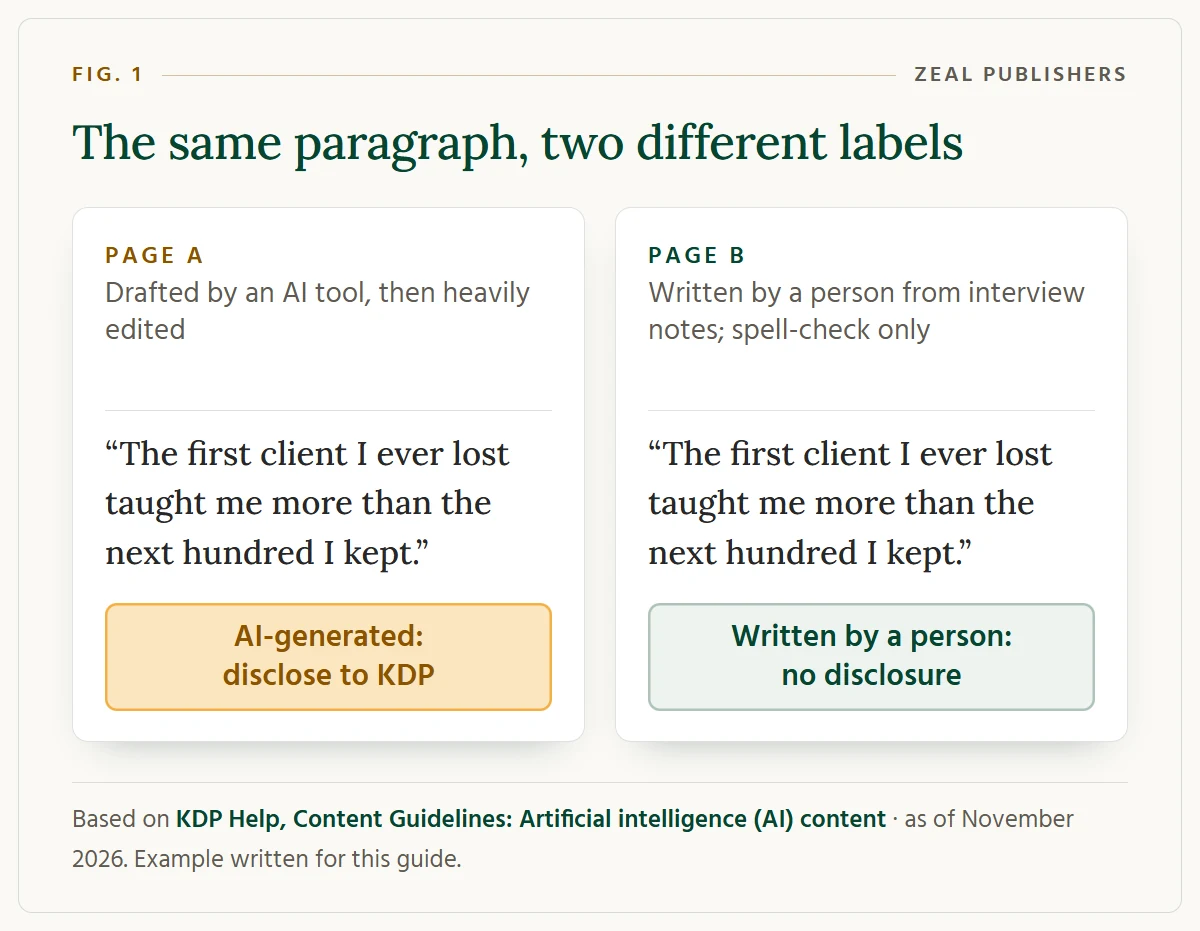
Disclosure isn't a ban; KDP's guidelines don't refuse AI-generated books. But it means the two routes now produce different books in a way that's on the record. Our full guide to publishing a book written with AI quotes every rule.
Where AI genuinely helps
Used as an assistant, AI is fast and cheap, and most of this work falls on KDP's AI-assisted side:
- Beating the blank page. Brainstorming angles, titles and chapter ideas, which you then write yourself.
- Research scaffolding. Summaries and question lists you verify against real sources and write up in your own words.
- Editing support. Catching repetition, flagging long sentences, checking spelling and grammar.
- Getting unstuck. Talking through a problem with a chapter before you sit down to write it.
If you enjoy writing and want a faster process, AI is a strong assistant, and as long as you write the text yourself, KDP doesn't ask you to disclose it.
Where AI falls short, and why it matters
- It doesn't know your story. The specific client, the failure that taught you everything, the way you actually talk: none of that is in a model. It's in you, and it comes out in an interview, not a prompt.
- It reads generic. AI prose is fluent and forgettable. For a book meant to build your authority, forgettable is the one thing you can't afford.
- It can state wrong details confidently. In anything researched or factual, every claim needs checking, which takes time the draft seemed to save.
- It has no judgment about your book. It can't decide what to leave out, what your reader actually needs, or what makes your argument land.
- Its text has to be disclosed, and may not be protected. Text an AI drafted is AI-generated on KDP however much you edit it. And the US Copyright Office's 2025 report says "copyright does not extend to purely AI-generated material, or material where there is insufficient human control over the expressive elements." Source: Copyright and Artificial Intelligence, Part 2. This is not legal advice; ask a publishing lawyer about your own book.
AI can get you a draft. Turning a draft into a book people finish and recommend is still human work, and so is knowing when a manuscript isn't ready.
If you write it yourself with AI: a workflow that stays AI-assisted
Writing your own book with an AI assistant is a perfectly good route, and it keeps the text yours. The habit that matters is keeping the tool on the right side of the line: it can help you think and check, but you write the sentences.
- Brainstorm, then close the tool. Use AI to list angles, questions or chapter ideas. Then write the chapter in a separate document, from your own notes, in your own words.
- Ask it to check, not to write. "Flag the sentences that are hard to follow" keeps you the author. "Rewrite this paragraph" hands the sentences to the tool. KDP treats refining your own content as AI-assisted, but the Authors Guild's Human Authored mark rules out AI rewriting full sentences, so decide early which standard you're writing to.
- Never paste generated text into the manuscript. Once AI-created text is in the book, it's AI-generated under KDP's rule, however much you change it afterward.
- Keep a dated note of what you used. Which tools, for what, and when. It answers KDP's question in a sentence, and any later question about how the book was made.
What a ghostwriter actually does
A ghostwriter isn't "AI that's slower." They interview you, draw out the stories and ideas you'd never think to write down, structure them into something a reader will follow, and write the book in your voice so it still sounds like you. For founders, executives and experts who have the substance but not the time, that's the whole job.
At Zeal, a ghostwritten book starts with recorded interviews to capture your voice, then the full manuscript written for you, with developmental and line editing. For a founder book, that's usually about four to six hours of interviews in total, spread across a few sessions. A ghostwritten book usually takes about three to six months, from the first interview to a finished manuscript. Here's what a ghostwriter does day to day.
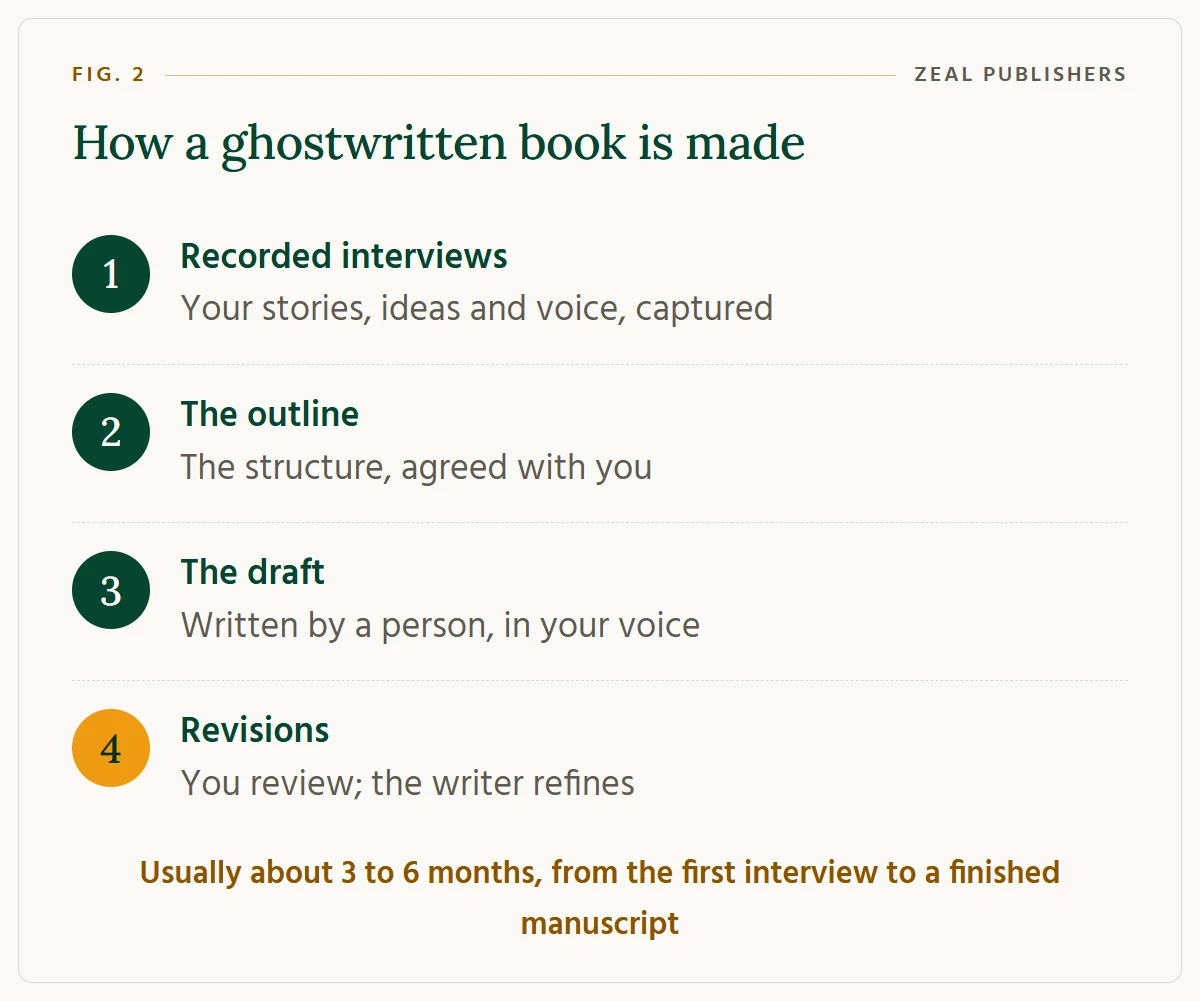
Because a person writes the text, a book written this way isn't AI-generated under KDP's definitions, even if the writer uses a tool to check spelling. That's worth confirming in writing with any ghostwriter you hire, as the questions below explain.
Head to head
| AI writing | Ghostwriter | |
|---|---|---|
| Cost | Low (a tool subscription) | Quoted per project; see the ranges below |
| Time | Minutes to a rough draft | About 3–6 months to a finished manuscript |
| Your real stories | Only what you type in | Captured in interviews |
| Voice | Generic unless you rewrite it | Yours |
| Fact reliability | Can invent details | Researched and checked |
| KDP disclosure (as of Nov 2026) | AI-drafted text: disclose | Written by a person: not AI-generated |
| Copyright in the text | Not for purely AI-generated material | Text a person wrote |
| Best for | Assistance, outlines, edits | A finished, authority-building book |
What each costs
AI writing tools cost a subscription. Ghostwriting is quoted per project, because the work scales with the book. Our ghostwriting cost guide publishes typical 2026 ranges by book type: from about $5,000 for a short business e-book up to $60,000 and more for a full-length, deeply researched book, with most founder memoirs, business books and company books landing between $12,000 and $35,000. The Ghostwriting Cost & Payback Planner places your own book in those ranges by type and length.
The honest comparison isn't the subscription against the fee. It's what each produces: an AI draft you still have to rewrite, disclose and stand behind, or a finished book in your voice.
The middle paths, and the one that doesn't work
Most authors don't choose purely one route. Here's how the common combinations sort under KDP's rule:
- You write it, with AI as an assistant. You draft every word; AI helps you brainstorm, outline or check spelling and grammar. That's AI-assisted. No disclosure.
- You write a rough draft yourself, and a ghostwriter or editor shapes it. A person wrote it and a person improved it. No AI-generated text, as long as nobody pasted in AI output.
- A ghostwriter writes fresh from interviews, using your AI notes only for ideas. Text a person writes fresh, using a draft only for ideas, counts as AI-assisted at most. The writer can use your notes as a map; the words are theirs and yours.
- You hand an AI draft to a person to edit. This is the one that doesn't change the label. However heavy the edit, KDP counts content an AI tool created as AI-generated. If you want a book you don't have to disclose, the text has to be written by a person, not edited from an AI draft.
Questions to ask a ghostwriter about AI
Whoever you hire, ask these before the work starts, and get the answers in writing:
- How will the text be produced? Interviews and original writing, or drafts generated by a tool?
- Will any AI tool create text, images or translations for the book? If yes, which parts, so you can answer KDP's question honestly.
- What tools will you use for editing and checking? Spelling and grammar tools are AI-assisted under KDP's definitions, and fine to use.
- What does the contract say about originality? A clear clause protects you both.
KDP puts the responsibility on the person publishing: "You are responsible for verifying that all AI-generated and/or AI-assisted content adheres to all content guidelines." A written answer from your writer is how you meet it.
So which should you choose?
- Use AI if you like writing, want a faster process, and will do the real work of writing the text yourself. AI as an assistant keeps you on KDP's AI-assisted side.
- Hire a ghostwriter if the book matters (it carries your name, your authority or your legacy) and you don't have the time, or don't want to gamble your reputation on generic prose and a disclosure label.
- Already have an AI draft? Treat it as notes. A person can write the book fresh from it and from interviews with you, in your voice.
Explore our ghostwriting services, or if you've written the book yourself and want it published, our self-publishing services. A book can build your authority for a decade. It's worth more than a prompt.
Check where your book stands
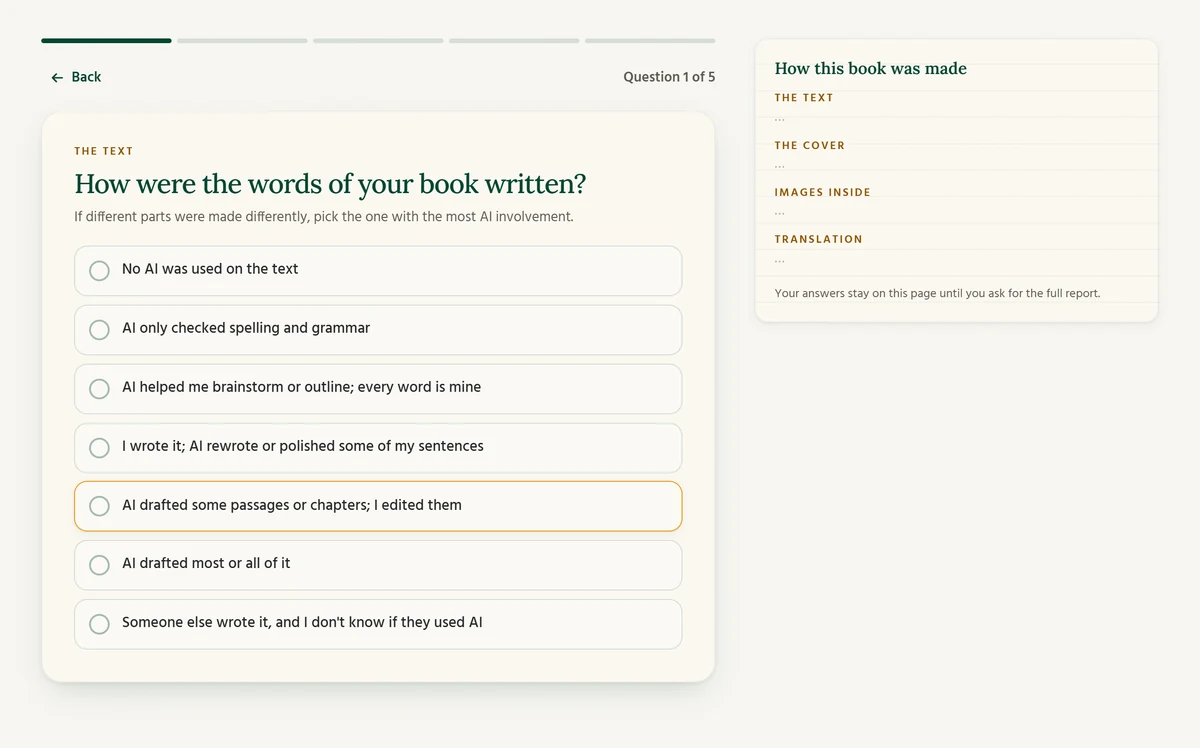
If you're not sure which side of KDP's line your book is on, the AI Book Check asks how your text, cover, inside images and translation were made, and tells you at once whether KDP asks you to disclose, quoting the exact rule behind each answer. It also gives you the Human Authored and copyright verdicts, and a dated record of how the book was made.
Frequently asked questions
Can AI write a whole book for me?
It can generate a full draft, but it can't interview you, doesn't know your real stories, and produces generic prose that needs heavy rewriting. And on Amazon KDP, text an AI tool drafted is AI-generated, and must be disclosed, even after substantial edits.
Do I have to tell Amazon if AI wrote my book?
Yes. KDP requires you to inform it of AI-generated text, images or translations when you publish, or edit and republish. Content you wrote yourself, with AI used only to edit, error-check or brainstorm, is AI-assisted and doesn't need to be disclosed.
Is a ghostwriter worth it if AI is basically free?
If the book carries your name and reputation, usually yes. A ghostwriter captures your actual voice and experience through interviews and writes the text as a person, so the book isn't AI-generated under KDP's definitions. Free but generic is expensive when the book is meant to build your authority.
How much does a ghostwriter cost compared with AI tools?
AI tools cost a subscription. Ghostwriting is quoted per project. Typical 2026 ranges run from about $5,000 for a short business e-book up to $60,000 and more for a deeply researched book, with most founder and business books between $12,000 and $35,000.
If a ghostwriter edits my AI draft, is it still AI-generated?
Yes. KDP counts content an AI tool created as AI-generated "even if you applied substantial edits afterwards." If you want text you don't have to disclose, a person has to write it fresh, using the AI draft for ideas at most.
How Zeal helps authors
- Self-Publishing
- Ghostwriting
- Book Editing
- Cover Design
- Audiobook Production
- Book Marketing
- Memoir Writing
- Costs & Answers
- Free AI Tools
Publishing by book type
Ready to make your book real?
We write, publish & market it for you. You keep 100% of your rights.
Talk to a Publisher →or call +1 (609) 493-4557 · Free author tools · Authors Circle · All pages