
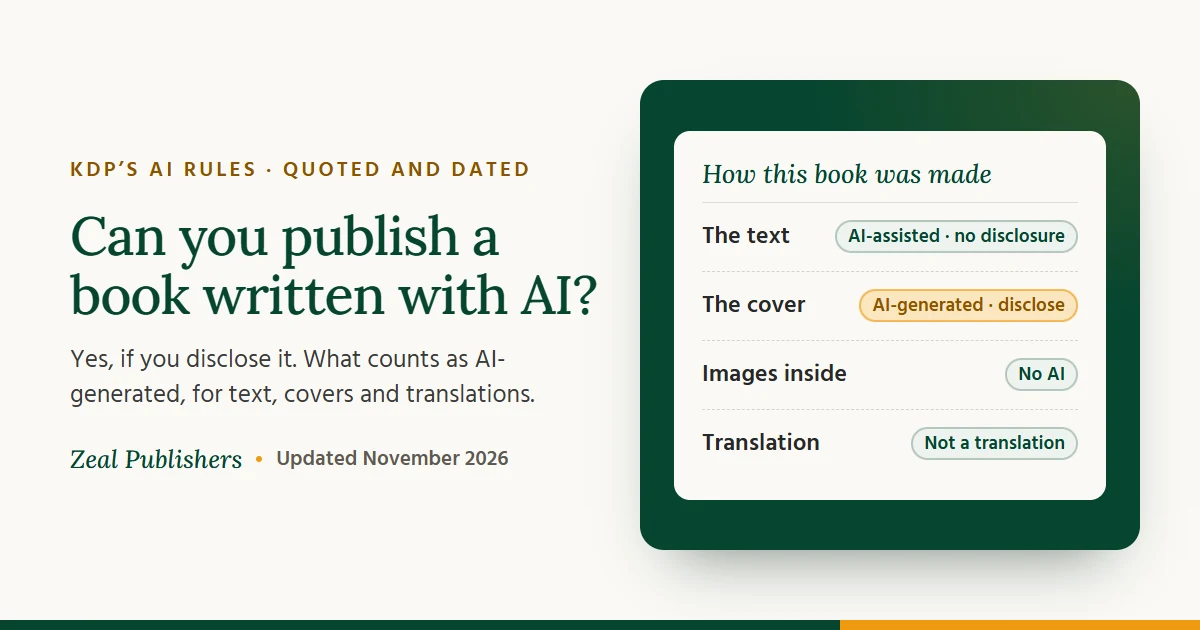
Yes, you can publish a book written with AI on Amazon KDP, but you have to tell KDP when the text, images or translations are AI-generated, at the moment you publish or republish. If you wrote the content yourself and used AI only to edit, refine, error-check or brainstorm, KDP calls that AI-assisted, and you don't have to disclose it. The line that catches most authors is this one: content an AI tool created stays AI-generated "even if you applied substantial edits afterwards."
That one sentence decides more books than any other, so this guide quotes it, and every other rule, word for word. The sources are KDP's own Content Guidelines, the US Copyright Office and the Authors Guild. As of November 2026: we read every rule below on its official page on November 2, 2026. Rules change, so each one links to the live page.
The rule, in KDP's own words
KDP's Content Guidelines have a section titled "Artificial intelligence (AI) content." Its core requirement is short:
We require you to inform us of AI-generated content (text, images, or translations) when you publish a new book or make edits to and republish an existing book through KDP.
Source: KDP Help, Content Guidelines: Artificial intelligence (AI) content, as of November 2026.
Three things in that sentence matter. It covers three kinds of content, not just the words. It applies when you publish, and again when you edit and republish, so a book that went live before you used AI on a new edition is not exempt. And it is a requirement to inform, not a ban. Nothing in the section says KDP refuses AI-generated books; it says you have to tell KDP about them, and that every book must still meet KDP's other content guidelines.
AI-generated or AI-assisted: the distinction that decides everything
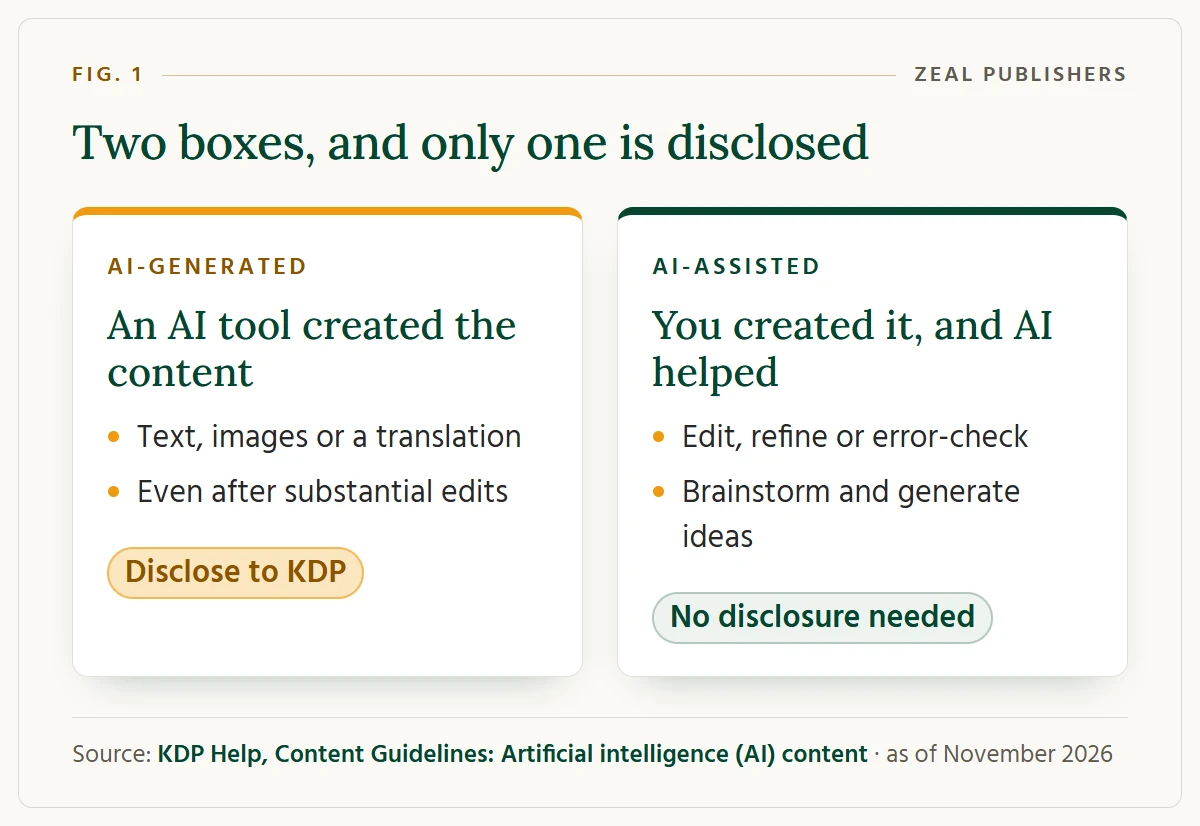
KDP sorts every use of AI into one of two boxes, and only one of them has to be disclosed.
AI-generated is content the tool made:
If you used an AI-based tool to create the actual content (whether text, images, or translations), it is considered "AI-generated," even if you applied substantial edits afterwards.
AI-assisted is content you made, which a tool then helped with:
If you created the content yourself, and used AI-based tools to edit, refine, error-check, or otherwise improve that content (whether text or images), then it is considered "AI-assisted" and not "AI-generated."
Brainstorming sits on the assisted side too:
Similarly, if you used an AI-based tool to brainstorm and generate ideas, but ultimately created the text or images yourself, this is also considered "AI-assisted" and not "AI-generated." It is not necessary to inform us of the use of such tools or processes.
And KDP states the consequence plainly: "You are not required to disclose AI-assisted content."
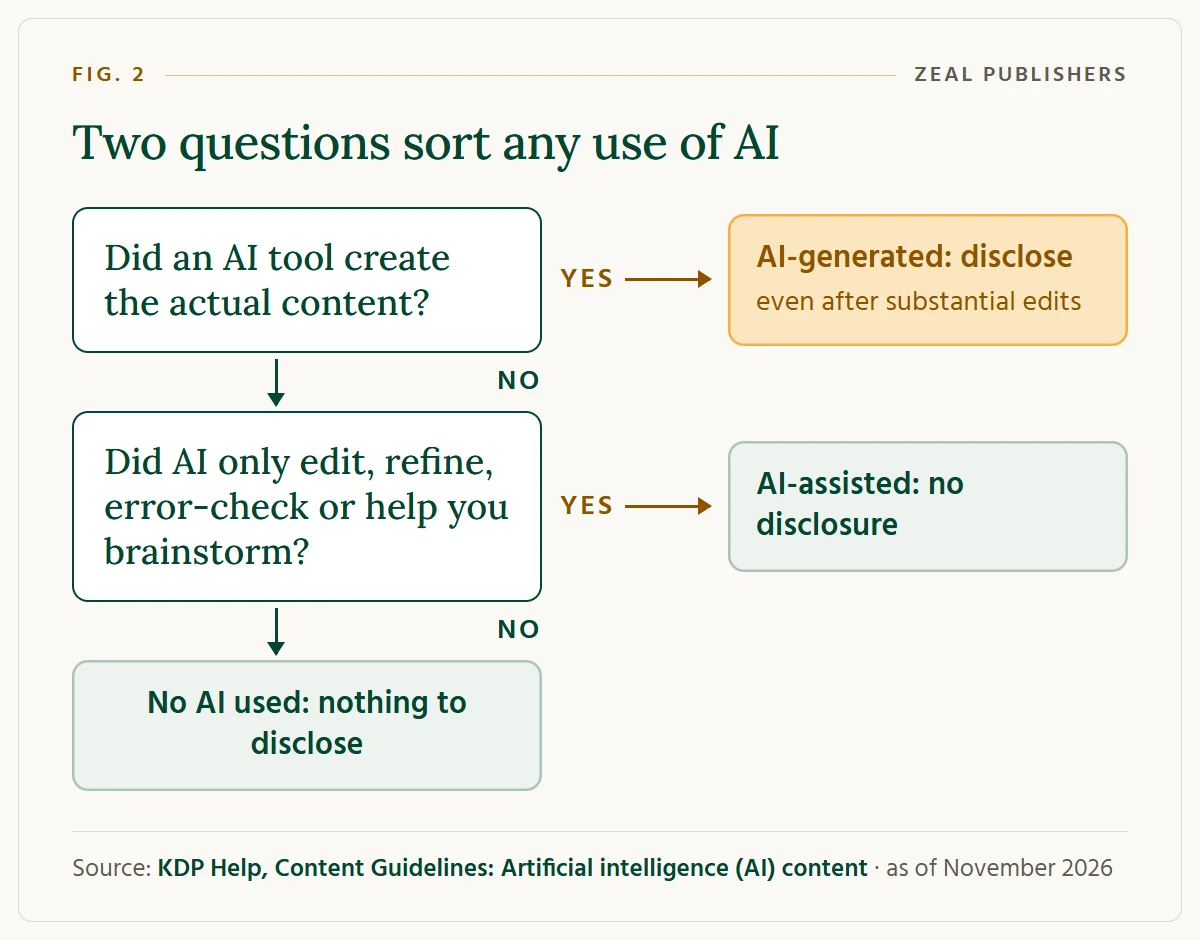
The test, in other words, is about origin, not polish. Ask who created the actual content. If the answer is an AI tool, the content is AI-generated, and no amount of editing moves it into the other box. If the answer is you, a tool that tidied, checked or suggested doesn't change that.
This is also why rewriting an AI draft until it "sounds human" achieves nothing under KDP's rule. The label follows how the content was made, not how it reads. If you want a book you don't have to disclose, the only route is for a person to write the text, using the AI draft for ideas at most.
Six common situations, sorted
Most authors' real workflows fall into one of these. Each line applies KDP's definitions above; the AI Book Check runs the same sort on your answers and shows the rule that decides each one.
- You wrote it, and used no AI at all. Nothing to disclose.
- You wrote it, and a tool checked spelling and grammar. AI-assisted ("error-check"). Nothing to disclose.
- AI helped you brainstorm or outline, and you wrote every word. AI-assisted ("brainstorm and generate ideas"). Nothing to disclose.
- You wrote it, and AI rewrote or polished some of your sentences. KDP treats editing and refining your own content as AI-assisted, so there is nothing to disclose to KDP. The Authors Guild draws a stricter line here, covered below.
- AI drafted some passages or chapters, and you edited them. Those passages are AI-generated. Disclose.
- AI drafted most or all of it. AI-generated. Disclose.
If your book sits in the first four, you're clear with KDP. Grammar tools still miss what a person notices: structure, voice, and the sentences that don't sound like you. That's the job of a human editing and proofreading pass.
If different parts of the book were made in different ways, sort each part separately, and answer KDP's question for the part with the most AI involvement. A memoir you wrote yourself, with one chapter an AI drafted from your notes, contains AI-generated text.
Covers, pictures and translations count too
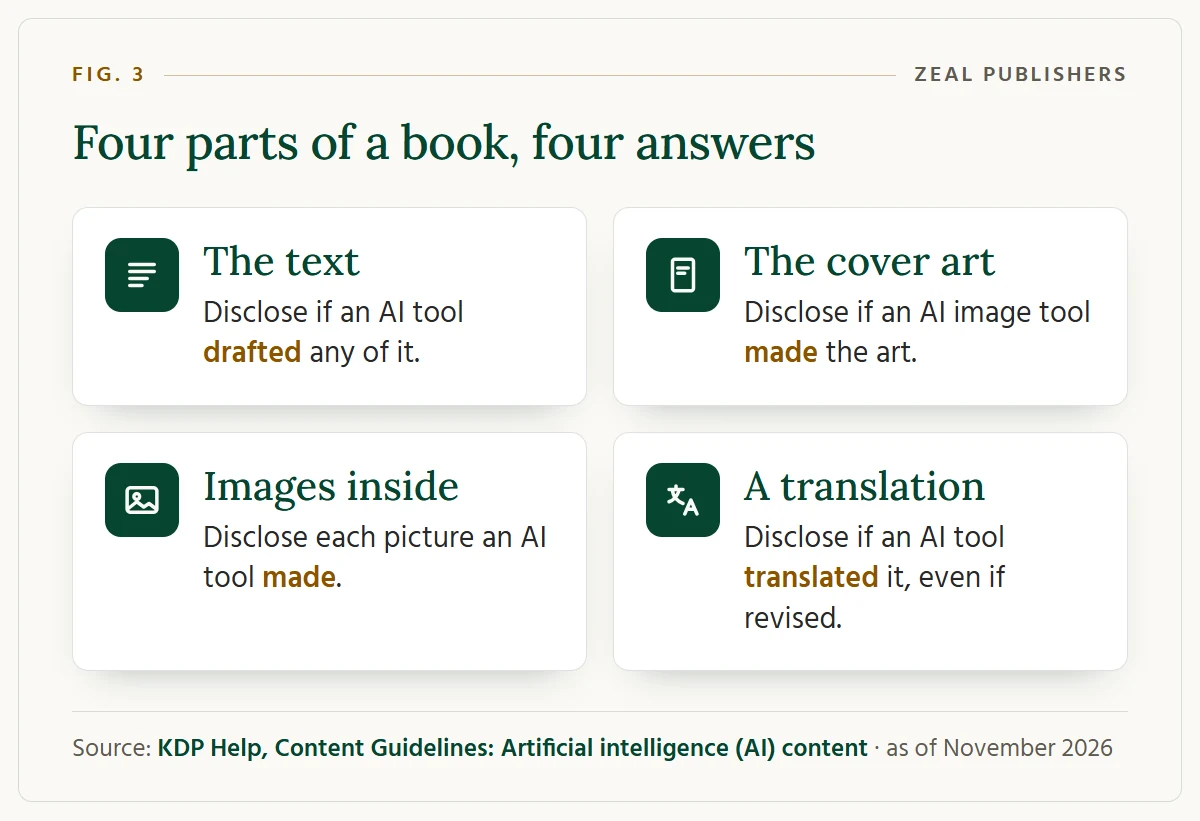
Authors tend to think about the words and forget the rest. KDP doesn't:
AI-generated images include cover and interior images and artwork.
So the same two boxes apply to every picture in and on the book:
- A cover art piece made with an AI image tool is AI-generated, even if a designer then edited it or added the title lettering. That is the "substantial edits" rule again, applied to images.
- A cover a person made, with AI used only to clean it up (color, sharpening, removing specks), is AI-assisted.
- Interior illustrations, photos, charts and decorations follow the same logic, picture by picture.
- A translation made with an AI tool is AI-generated, even after a person revises it, because the tool created the translated text.
If your cover was AI-generated and you'd rather not disclose one, the fix is a cover a person designs from scratch, not an edit of the AI art. Our cover design service makes covers that way.
When someone else wrote part of the book
Many books have more than one pair of hands on them: a ghostwriter, a co-author, an editor, an illustrator, a translator. KDP's rule doesn't change with the number of people. It asks you, the person publishing, to tell it about AI-generated content, and it puts the responsibility on you:
You are responsible for verifying that all AI-generated and/or AI-assisted content adheres to all content guidelines, including by complying with all applicable intellectual property rights.
The practical step is simple. Before you publish, ask everyone who created part of the book for a short written statement of how they produced it, and whether any AI tool created text, images or a translation. If you can't get that answer, you can't answer KDP's question honestly, so get it in writing first.
If you're hiring someone to write the book, ask the question before the work starts. A ghostwriter who interviews you and writes the text fresh, in your voice, produces text that a person created. Under KDP's definitions, text a person writes that way is not AI-generated, even if they used a tool to check their spelling. Our guide to AI book writing vs a ghostwriter compares the two routes in full.
What disclosure is, and what it isn't
Disclosure is a statement of fact to KDP about how the book was made. It is not a penalty, and KDP's guidelines don't describe it as one.
KDP doesn't publish how it checks for AI content, and we don't guess. Its rule rests on honesty, not detection: you tell it what was AI-generated, and you are responsible for your content. We won't help anyone hide AI use, and AI-detector scores are not a reliable answer either way, so they aren't a way to decide what to disclose. The answer comes from how the book was made, which you already know or can find out.
Copyright is a separate question
KDP's rule decides what you tell Amazon. Whether you own a copyright in the book is a different question, answered by copyright law. In the United States, the US Copyright Office has set out its position in two documents.
Its 2023 registration guidance sets a duty to disclose:
applicants have a duty to disclose the inclusion of AI-generated content in a work submitted for registration and to provide a brief explanation of the human author's contributions to the work.
And it says what to leave out: "AI-generated content that is more than de minimis should be explicitly excluded from the application." Source: US Copyright Office registration guidance, 88 Fed. Reg. 16190, March 16, 2023.
Its January 2025 report on copyrightability draws the line between assisting and replacing:
The use of AI tools to assist rather than stand in for human creativity does not affect the availability of copyright protection for the output.
Copyright does not extend to purely AI-generated material, or material where there is insufficient human control over the expressive elements.
It also addresses prompts directly: "Based on the functioning of current generally available technology, prompts do not alone provide sufficient control." Source: Copyright and Artificial Intelligence, Part 2: Copyrightability, January 2025.
Put together, this means the words you wrote are yours to protect, AI used as a helper doesn't change that, and text an AI drafted is not protected unless a person's own expression, selection, arrangement or changes are in it. None of this is legal advice. For a question about your own book, ask a publishing lawyer.
The Authors Guild's Human Authored mark is stricter
Some authors want to say more than "no disclosure needed." The Authors Guild runs a Human Authored certification, and its definition is narrower than KDP's AI-assisted box:
“Human Authored” means that the text of the book was written by a human and not generated by AI, with the exception of minimal uses such as AI applications that check spelling and grammar or for research.
Two limits matter most. Sentence rewriting is out: "Using AI to rewrite full sentences or in any way that incorporates more than a de minimis amount of AI-generated text ... is not acceptable and makes the manuscript ineligible for Human Authored certification." And outlining is allowed only "at a very high level ... provided the AI use is merely preparatory and no actual AI-generated text appears in your work." The Guild also says that "using the Human Authored certification mark on AI-generated cover art goes against the spirit of the program."
So situation 4 above, where AI polished some of your sentences, is fine for KDP but rules out the Guild's mark. As of November 2026, the certification is open to authors of books published in the United States, members or not. It is free for members and $10 per title for non-members, with identity verification, and it is a self-certification: you sign a license promising the book is Human Authored. Source: the Authors Guild's Human Authored FAQ. Zeal Publishers is not connected with the Authors Guild.
Other platforms set their own rules
KDP isn't the only place to publish. IngramSpark, Draft2Digital, Apple Books and Barnes & Noble Press publish their own content guidelines, and they change. We couldn't verify their AI rules from their own pages, so we make no claim about them here. Read each one's current rules on AI before you upload; some platforms do not accept books generated by AI. If you're going to a traditional publisher, tell your editor or agent exactly how AI was used, and read your contract's promises about originality before you sign. If you're not sure where your book stands, a free 15-minute call with a publisher will sort it out.
Keep a record of how the book was made
The most useful habit in all of this costs nothing. Keep a short, dated note of how each part of the book was made: which tools, for which parts, and who did the work. It answers KDP's question in seconds, it's what a copyright application asks you to describe, and it settles questions later, when you republish or someone asks.
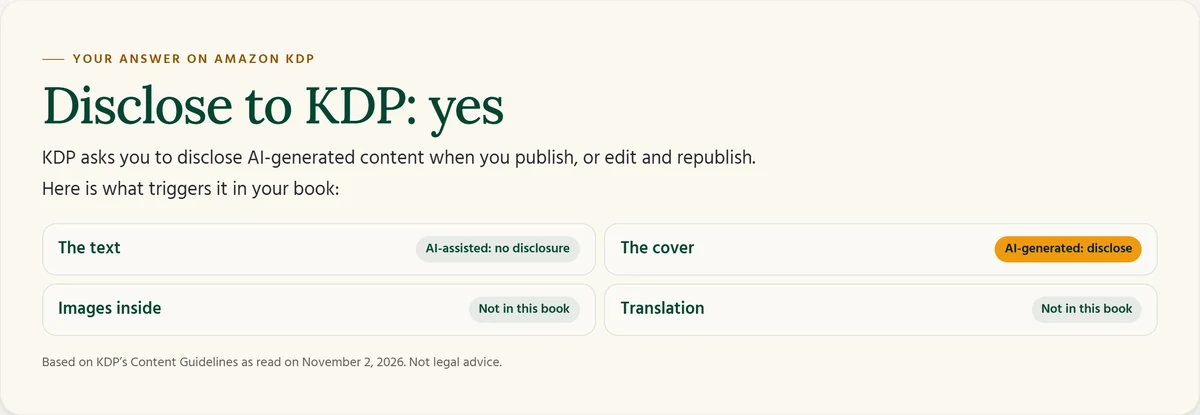
Check your own book in two minutes
The AI Book Check asks how your text, cover, inside images and translation were made, and tells you at once whether KDP asks you to disclose. It quotes the exact words in KDP's rule that decide each answer, adds the Human Authored and copyright verdicts, and writes the dated "How this book was made" record for you. It's free, and it never suggests hiding anything.
Frequently asked questions
Can I publish a book written with AI on Amazon?
Yes. KDP's guidelines don't ban it. They require you to tell KDP about AI-generated text, images or translations when you publish, or edit and republish, and every book must still meet KDP's other content guidelines. AI-assisted work, where you wrote the content and AI only edited it or helped you brainstorm, does not need to be disclosed.
If I heavily edit an AI draft, is it still AI-generated?
Yes. KDP counts content an AI tool created as AI-generated "even if you applied substantial edits afterwards." Text you write yourself, using AI only for ideas, counts as AI-assisted.
Can I publish a book with AI-generated images or an AI cover?
Yes, but you have to disclose them. KDP says AI-generated images include cover and interior images and artwork. A cover a person made, with AI used only to clean it up, counts as AI-assisted and needs no disclosure.
Can Amazon KDP detect AI writing?
KDP doesn't publish how it checks. Its rule is about honesty, not detection: you tell it what was AI-generated, and you are responsible for your content. Detector scores are not a reliable answer either way, so decide from how the book was actually made.
Can I copyright a book written with AI?
You can register the parts a person wrote. The US Copyright Office says copyright does not extend to purely AI-generated material, and that applicants must disclose AI-generated content and exclude it when it is more than de minimis. This is not legal advice; ask a publishing lawyer about your own book.
How Zeal helps authors
- Self-Publishing
- Ghostwriting
- Book Editing
- Cover Design
- Audiobook Production
- Book Marketing
- Memoir Writing
- Costs & Answers
- Free AI Tools
Publishing by book type
Ready to make your book real?
We write, publish & market it for you. You keep 100% of your rights.
Talk to a Publisher →or call +1 (609) 493-4557 · Free author tools · Authors Circle · All pages