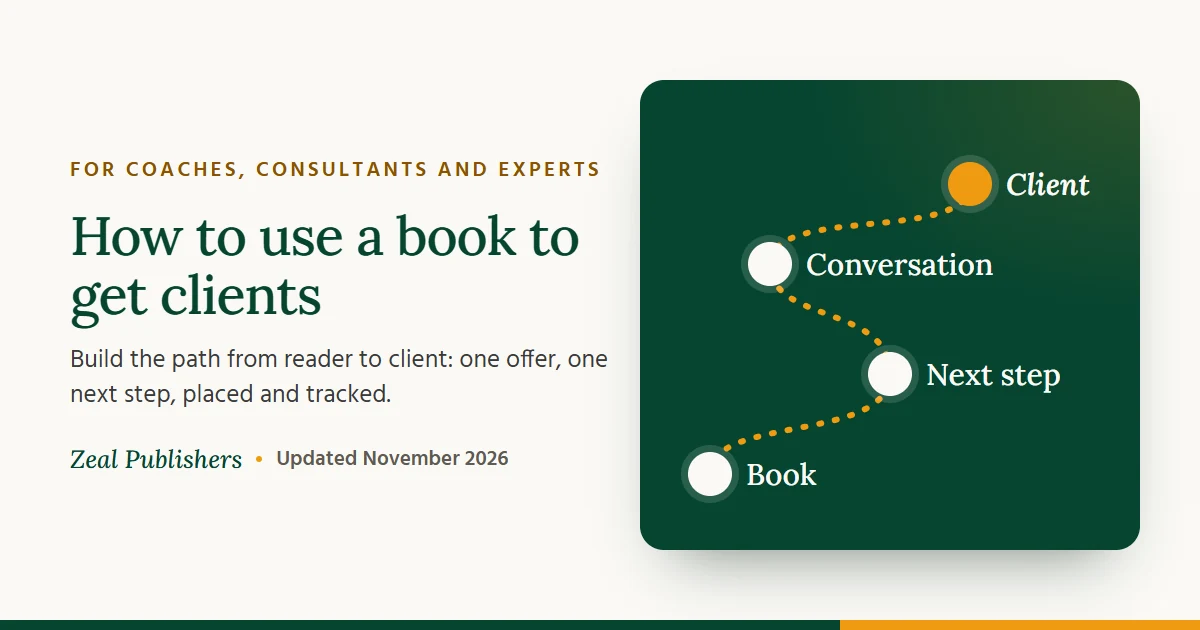
A book brings in clients when it's built to lead somewhere: one offer it's written for, one next step a reader can take the day they finish, that step placed where readers will meet it, and a simple way to tell which clients came from the book. Most expert books that don't bring in work aren't bad books. The reader finishes, agrees with every chapter, and has nowhere to go.
This guide is about that gap, the path from reader to client. It's written for coaches, consultants, advisors and other experts who sell their time or their method. If you're still deciding whether to write a book at all, start with why founders should write a book or our comparison of a book, a blog and a podcast. This piece assumes the book is coming and asks what it should do.
Why good books often bring in no clients
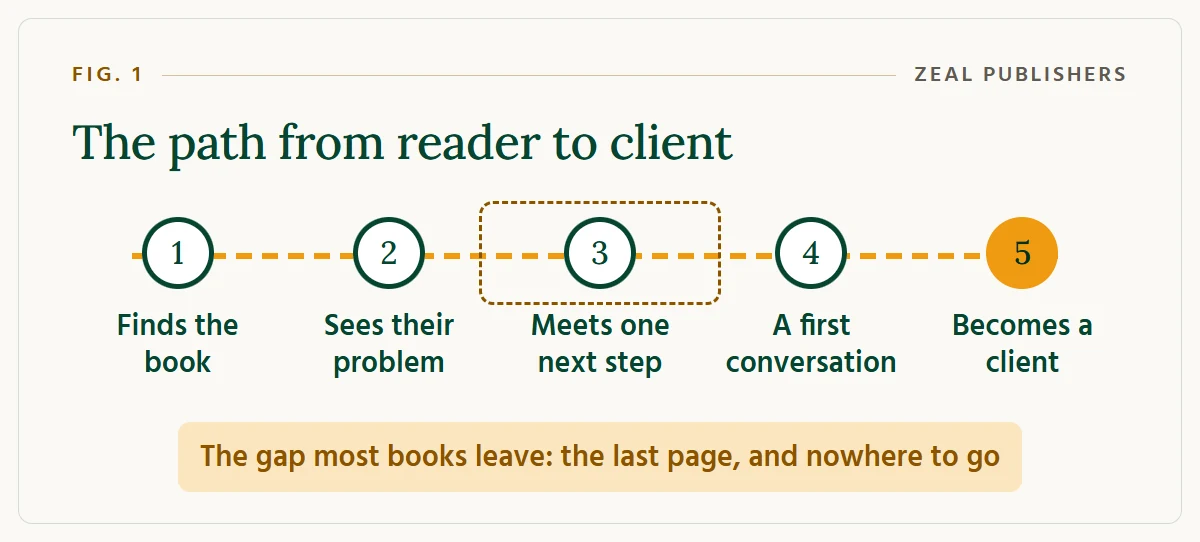
Picture the reader who would make your ideal client. They found your book, read it over two weeks, underlined things, and finished it convinced. Then they closed it.
At that moment, three things decide whether they ever contact you. They need to know there's a next step. They need to believe the step is meant for someone like them. And it has to be easy enough to take now, before the feeling fades.
Most expert books fail all three without anyone noticing. The author bio lists a website. The last chapter ends on an inspiring note. There's no single, specific thing to do. The Authority Readiness Score puts it bluntly when a book has no next step: readers enjoy it and move on.
None of this is about writing quality. It's design, and you can do it before a word of the manuscript is written.
Step 1: Decide the one offer the book is written for
A book that serves every offer you have serves none of them. Before the outline, pick the one offer you most want readers to arrive at. Usually it's your core engagement: the program, the advisory work, the diagnostic, the retained service. It's the thing you'd most like more of, at a price you're glad to be paid.
Then make the book's job explicit. Write one sentence: "This book exists so that the right reader understands [the problem], trusts [my way of solving it], and takes [this step] toward [this offer]." If you can't finish the sentence, the book doesn't have a job yet. That's exactly what the "revenue plan" area of the Authority Readiness Score checks: what the book is for, and what a reader does after the last page.
A single offer doesn't make the book a sales pitch. It makes the book coherent. Every chapter can serve the reader fully and still point the same way, because the offer is the natural next stage of the problem the book is about.
Step 2: Write so the right readers recognize themselves
The readers who become clients are the ones who see their own situation on the page. So the book has to name the problem in their language, with their details, at their stage.
Three choices make that happen:
- Write for one reader. A consultant who works with family-owned manufacturers should write for the second-generation owner, not for "business leaders." Specific readers self-select; general ones drift.
- Teach the method in full. Withholding the "how" so readers have to hire you is the most common mistake in expert books, and it backfires. A book that holds back reads like a brochure. A book that gives everything away shows readers how much there is to do, and who has done it before.
- Show the work with help. Somewhere in the book, describe honestly what it looks like to apply the method with a guide: what changes, what it takes, who it suits and who it doesn't. That's not a pitch. It's information the right reader wants.
The test is simple. Your ideal client should finish the book thinking, "This person understands my problem better than anyone I've talked to." Your wrong-fit reader should finish it knowing they can do it themselves, and be glad they bought the book.
Step 3: Design one next step worth taking
The next step is the bridge between the book and the offer. It should be useful on its own, specific to the book, and easy to start the day someone finishes reading.
Good next steps tend to be one of these:
- An assessment or scorecard based on the book's method, which tells the reader where they stand and what to do first.
- A diagnostic session, free or priced, framed around the book's model.
- A workbook or template pack that applies a chapter's framework to the reader's own situation.
- A small first engagement with a clear price: a workshop, a review, a one-day intensive.
The step with a price on it is often the stronger one. A free call is easy to offer and easy to ignore; a defined, priced first step tells the reader exactly what they'll get. The Authority Score's advice for a weak revenue plan is the same: decide the one next step a reader should take, and give it a price.
Whatever you choose, keep it to one. Three options at the back of the book read as a menu, and menus slow people down.
Step 4: Put the next step where readers will meet it
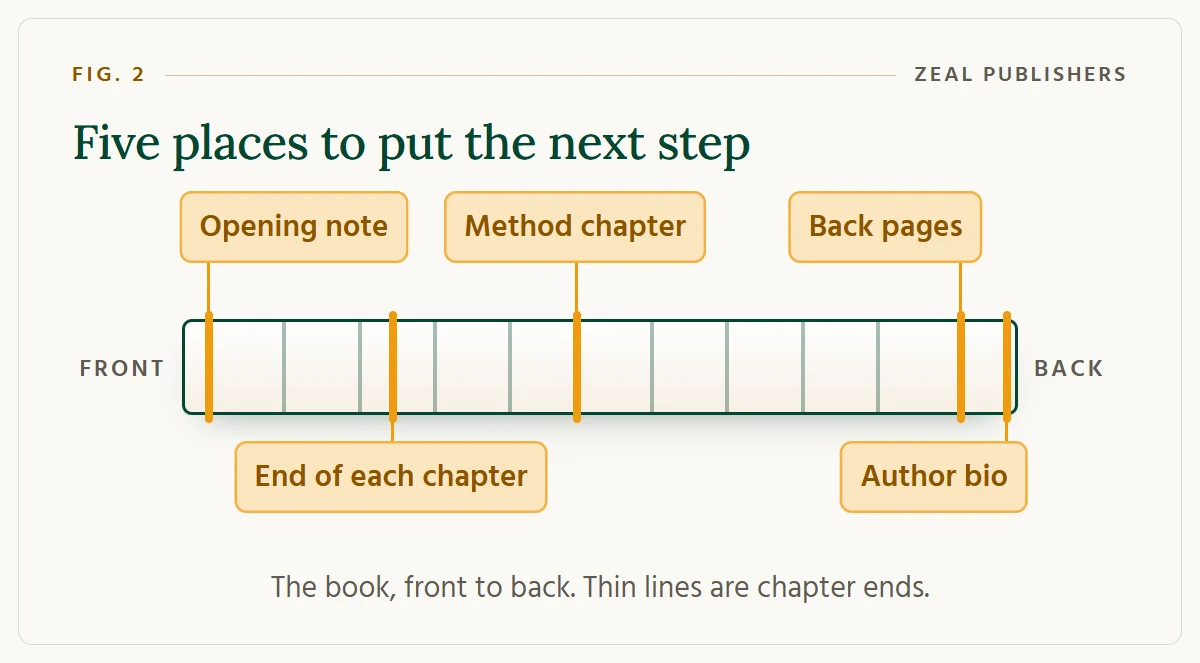
A next step on the last page reaches only the readers who get to the last page. Plenty of readers who'd make good clients read three chapters and the conclusion. So place the step where every kind of reader will pass it:
- The opening pages. A short note before chapter one: "Throughout this book you'll find [the assessment]. It takes ten minutes, and it's at [your book's web address]."
- The end of each chapter. One line connecting the chapter to the tool: "To see where your team stands on this, take part two of the assessment."
- The chapter that teaches the method. This is where the reader most wants to apply it, so it's where the workbook or template belongs.
- The back pages. The full invitation: what the next step is, who it's for, what it costs, and how to start.
- The author bio. One sentence about the offer, not a list of credentials.
Use one web address for all of it, something short and specific to the book, like yourname.com/book. A reader should be able to type it from memory after seeing it a few times. It also makes the next part possible.
Step 5: Make the book's clients visible
If you can't tell which clients came from the book, you can't tell whether it's working, and you can't improve it. Measurement here doesn't need software. It needs three habits:
- A book-only web address. Everything in the book points to the page at yourname.com/book. Visits to it come from readers.
- One question on your intake form. "How did you hear about us?" with "I read the book" as an option. It's low-tech, and it's the most reliable signal you'll get.
- A note on every new client. In your CRM or spreadsheet, tag each client with where they came from. After a year, you'll know what the book did, in your own numbers rather than anyone's averages.
Be patient with what you see. A book's readers often contact you months after they finish, sometimes after passing it to the person who signs the contract. A slow start isn't a failing book.
Step 6: Put the book in front of people who could hire you
Waiting for strangers to find a book on a store shelf is the slowest way for it to bring in clients. The faster route is to put it in the hands of people already near a decision:
- After a first conversation, send the book instead of a slide deck. It answers the questions the prospect didn't ask.
- To past clients and referral partners, with a note. They're the people most likely to pass it on.
- At every talk, workshop and podcast, where the book gives the audience something to take home and a reason to look you up.
- In proposals, as the explanation of your method, so the proposal itself can stay short.
This is where a book outperforms most marketing. It keeps working after the meeting, in rooms you're not in.
Three things that quietly break the path
A generic invitation. "Visit my website to learn more" asks the reader to do the work of finding the next step. Name the step, say what it is, and give the exact address.
A next step that doesn't match the book. If the book teaches a method for fixing hiring, the next step should be about hiring, not a general strategy call. The closer the step is to the last chapter the reader finished, the more natural it feels to take.
A path that changes after launch. Printed copies last for years. If the web address in the book stops working, or leads to a page about something else, every copy in circulation stops sending you readers. Pick an address you'll keep, and point it wherever your current next step lives.
Work out whether the book pays for itself, with your own numbers
The payback question is simpler than it looks, and you're the only one who can answer it, because it depends on what a client is worth to you.
Start with one number: what one new client, engagement or deal is worth to you, over the whole relationship. Then compare it to what the book costs. If you're writing it yourself, the cost is your time plus editing, design and publishing. If you're hiring a ghostwriter, our ghostwriting cost guide publishes typical 2026 ranges by book type: for example, $5,000 to $12,000 for a short business e-book of 10,000 to 20,000 words, and $12,000 to $25,000 for a founder story or personal brand book of 30,000 to 50,000 words.
Divide the cost by the value of one client. That's how many clients the book has to bring in to pay for itself. For many consultants and coaches, the answer is a small number, which is why the reader-to-client path matters more than the size of the audience.
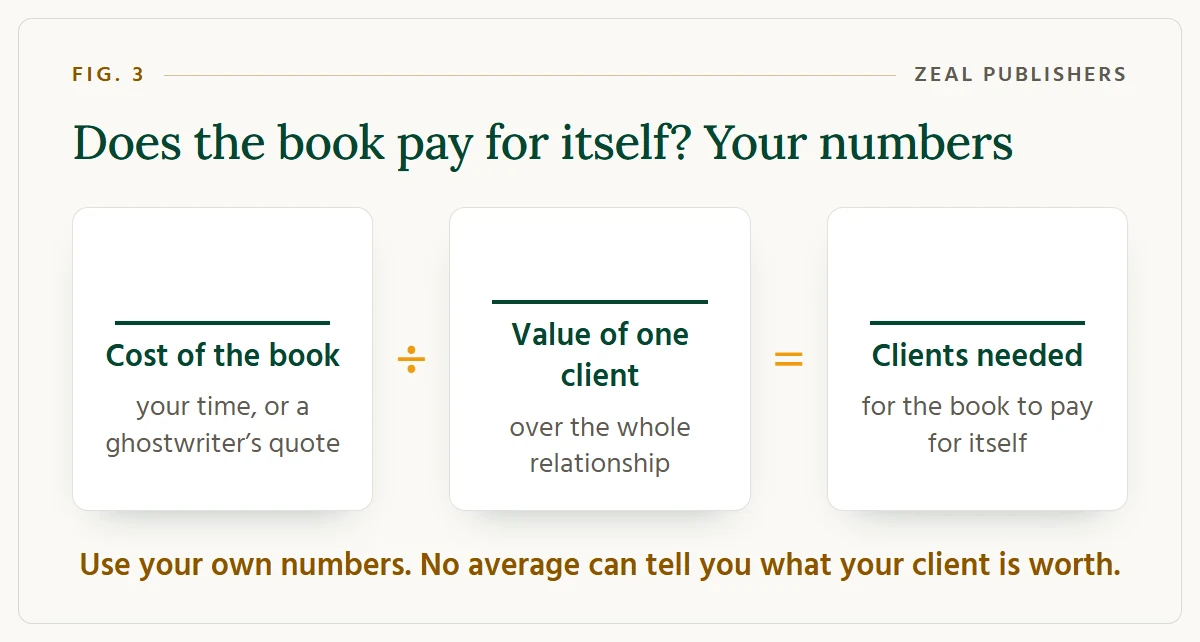
The Ghostwriting Cost & Payback Planner does this sum with your numbers: it places your book in the published price range for its type and length, then shows how many clients would cover it. It doesn't guess how many readers will become clients, because nobody honestly can.
Check your readiness before you start
A book with a clear path to an offer works best for experts who already have the pieces: proof that the method works, a few places where people hear from you, and an offer worth arriving at. If one of those is missing, it's usually better to know now, while the book is being planned, than after it's published.
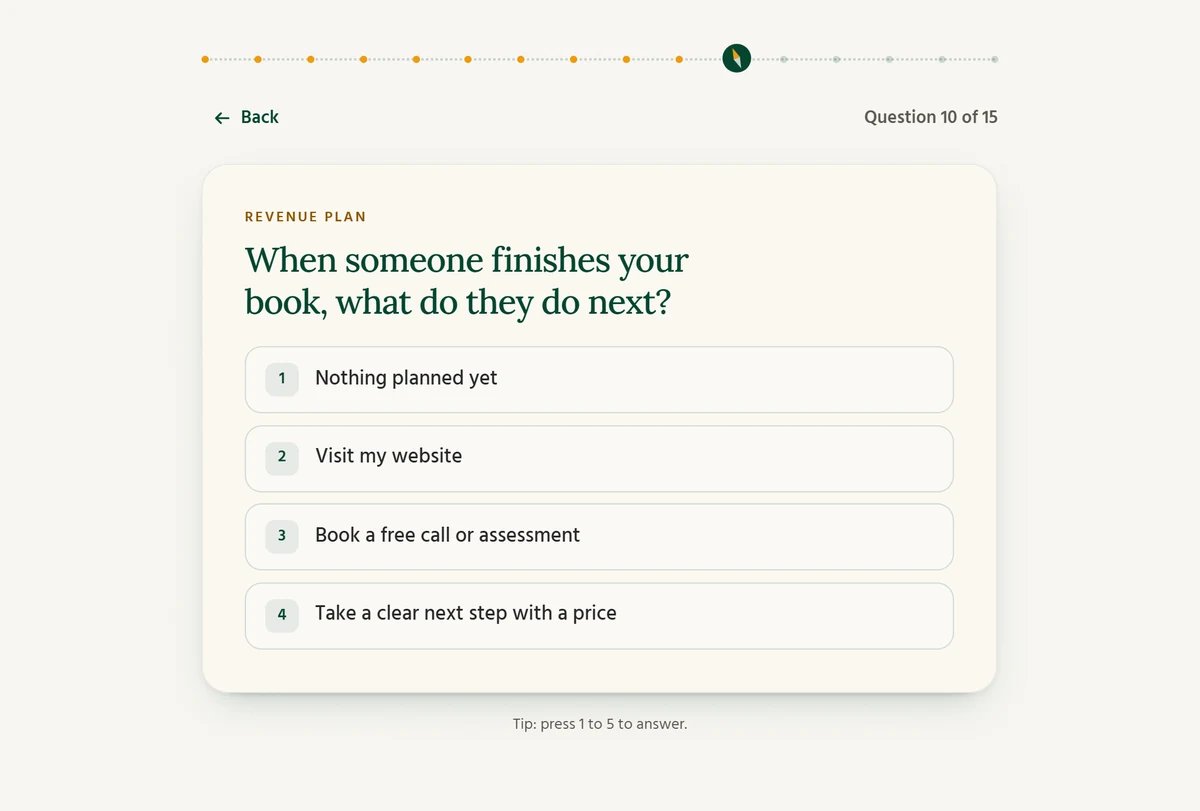
The Authority Readiness Score asks 12 short questions across five areas (proof, audience, stage, revenue plan and material) and gives you a score out of 100, with your weakest area and a 90-day plan. Its revenue-plan questions are the ones in this guide: what one new client is worth to you, what the book should do for your work, and what a reader does after the last page.
Get my Authority Readiness Score →
If the score says you're ready, our authority book service for professionals writes, brands and launches the book, with the path to your offer built in from the outline.
Frequently asked questions
Can a book really get you clients?
Yes, when it's built to. A book brings in clients when it's written for one offer, gives readers one clear next step, puts that step where they'll see it, and reaches people who could hire you. A book without a next step tends to build goodwill rather than work.
What should go at the end of a business book?
One specific invitation: what the next step is, who it's for, what it costs, and how to start, at one short web address. Repeat a shorter version at the start of the book and at the end of each chapter, because many readers never reach the last page.
Should my book give away my method?
Yes. Holding back the "how" makes a book read like a brochure. Teaching the method in full shows readers how much is involved and why help is worth paying for. The right clients still hire the person who wrote it.
How do I know which clients came from my book?
Point everything in the book to one book-only web address, add "I read the book" to your intake form's "How did you hear about us?" question, and tag each new client by source. After a year, your own records tell you what the book did.
How much does it cost to have a business book written?
Our ghostwriting cost guide publishes typical 2026 ranges: about $5,000 to $12,000 for a short business e-book, $12,000 to $25,000 for a founder story or personal brand book, and $15,000 to $35,000 for a company or thought-leadership book. The final quote depends on length, research and interviews.
How Zeal helps authors
- Self-Publishing
- Ghostwriting
- Book Editing
- Cover Design
- Audiobook Production
- Book Marketing
- Memoir Writing
- Costs & Answers
- Free AI Tools
Publishing by book type
Ready to make your book real?
We write, publish & market it for you. You keep 100% of your rights.
Talk to a Publisher →or call +1 (609) 493-4557 · Free author tools · Authors Circle · All pages