
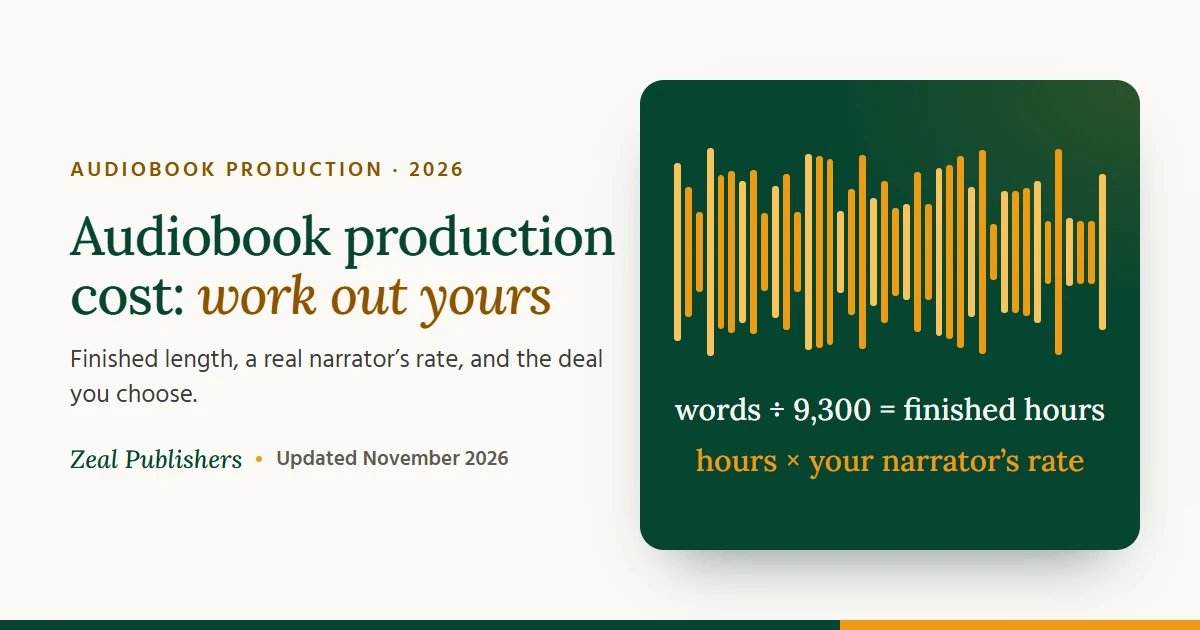
If you pay a narrator upfront, an audiobook's production cost is its finished length times the narrator's rate per finished hour. ACX says most narrators record about 9,300 words per hour, so divide your word count by 9,300 to get the hours: a 60,000-word book comes to about 6.5 finished hours. ACX doesn't publish a typical rate, because narrators set their own, so the only real figure for the rate is a quote. If you can't pay upfront, ACX's Royalty Share deal costs nothing upfront, and you split the royalties with the narrator for seven years instead.
That's the whole calculation. The rest of this guide is about getting the inputs right: your length, a real rate, the deal you choose, and what the 2026 changes to Audible's royalties mean for the decision.
As of November 2026: every ACX and KDP rule here comes from their official help pages, read on November 2, 2026. We've removed the narrator rate ranges this guide used to give: ACX doesn't publish typical rates, and we won't print figures we can't source.
Step 1: Work out your finished length
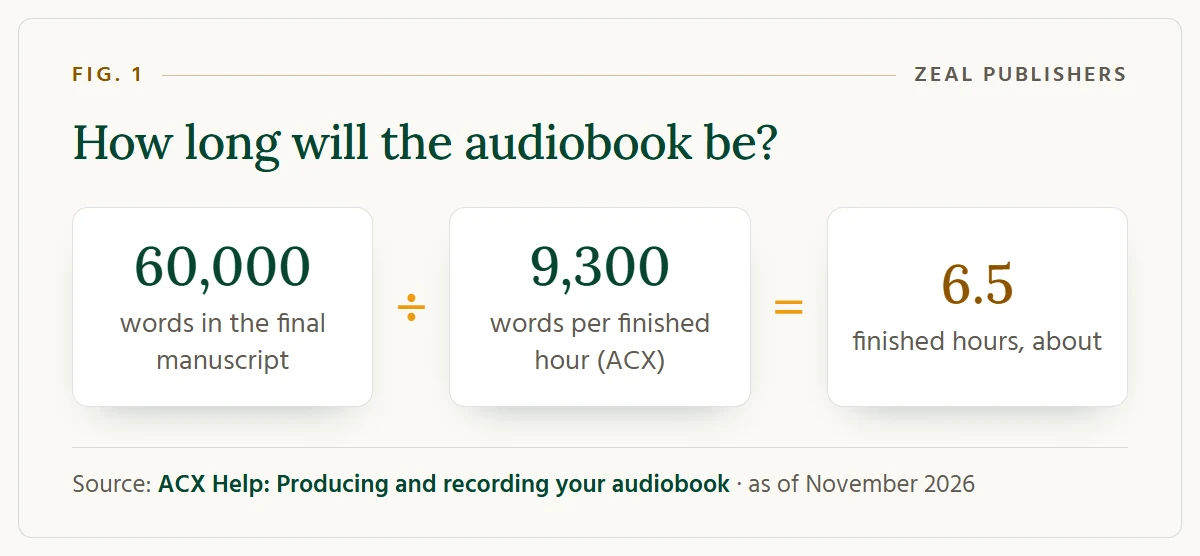
Length drives everything else, and it's the one number you can know exactly before you talk to anyone. ACX's guidance:
On average, most performers narrate about 9,300 words per hour.
Source: ACX Help: Producing and recording your audiobook, as of November 2026.
So the formula is your word count divided by 9,300. Here's what that gives at common book lengths:
| Word count | Finished length (about) |
|---|---|
| 30,000 | 3.2 hours |
| 40,000 | 4.3 hours |
| 50,000 | 5.4 hours |
| 60,000 | 6.5 hours |
| 70,000 | 7.5 hours |
| 80,000 | 8.6 hours |
| 90,000 | 9.7 hours |
| 100,000 | 10.8 hours |
"Finished hours" means the length of the final, edited audiobook, not the time the narrator spends in the booth, which is longer. Rates are quoted per finished hour, so this is the number that matters.
Use your final word count, after editing. A manuscript that shrinks from 85,000 to 72,000 words in the edit saves about 1.4 finished hours of narration.
Step 2: Get a real rate, and multiply
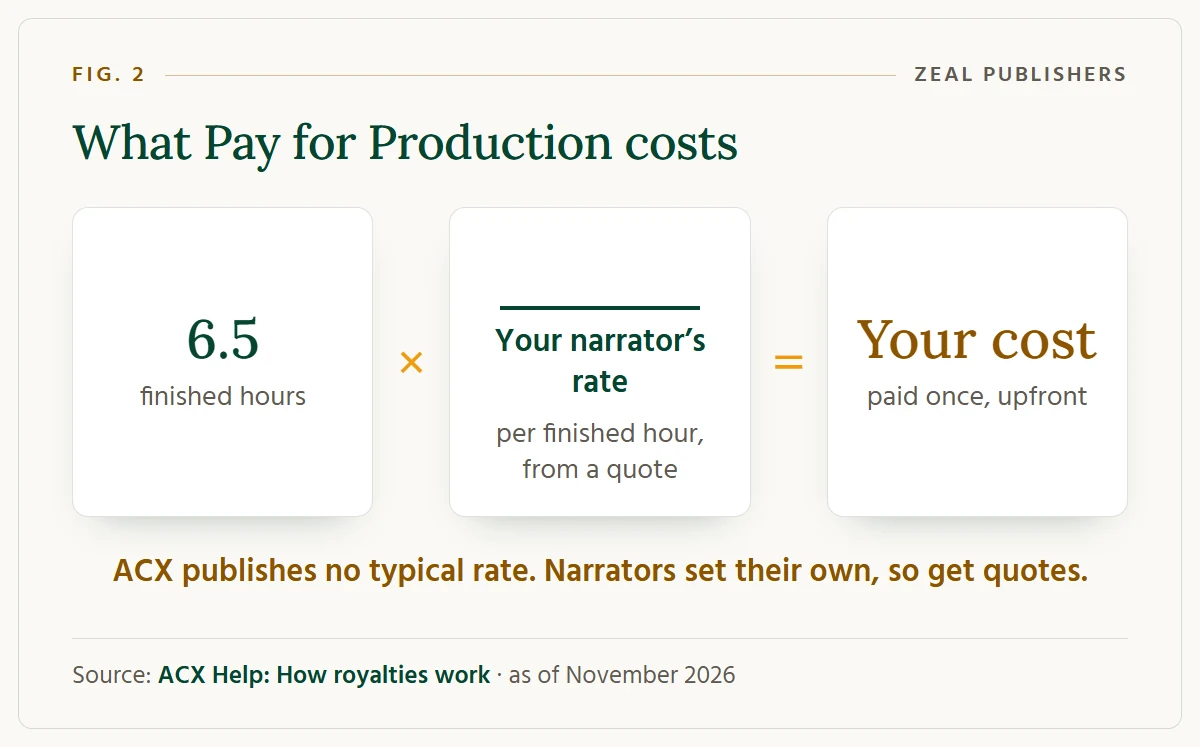
On ACX's Pay for Production deal, in ACX's words, "A Pay-for-Production deal is a one-time flat fee based on the length of the finished audiobook." So:
Production cost = finished hours × the narrator's rate per finished hour
ACX doesn't publish a typical or recommended rate, and narrators set their own. Any range you see quoted as "the going rate" is someone's estimate, not ACX's. The reliable way to get the number is to ask two or three narrators whose sample suits your book for a quote.
To show how the arithmetic works, take an example rate of $250 per finished hour, the same example our planner starts on. It's an illustration, not a typical or recommended rate:
- A 60,000-word book: 6.5 hours × $250 = $1,625.
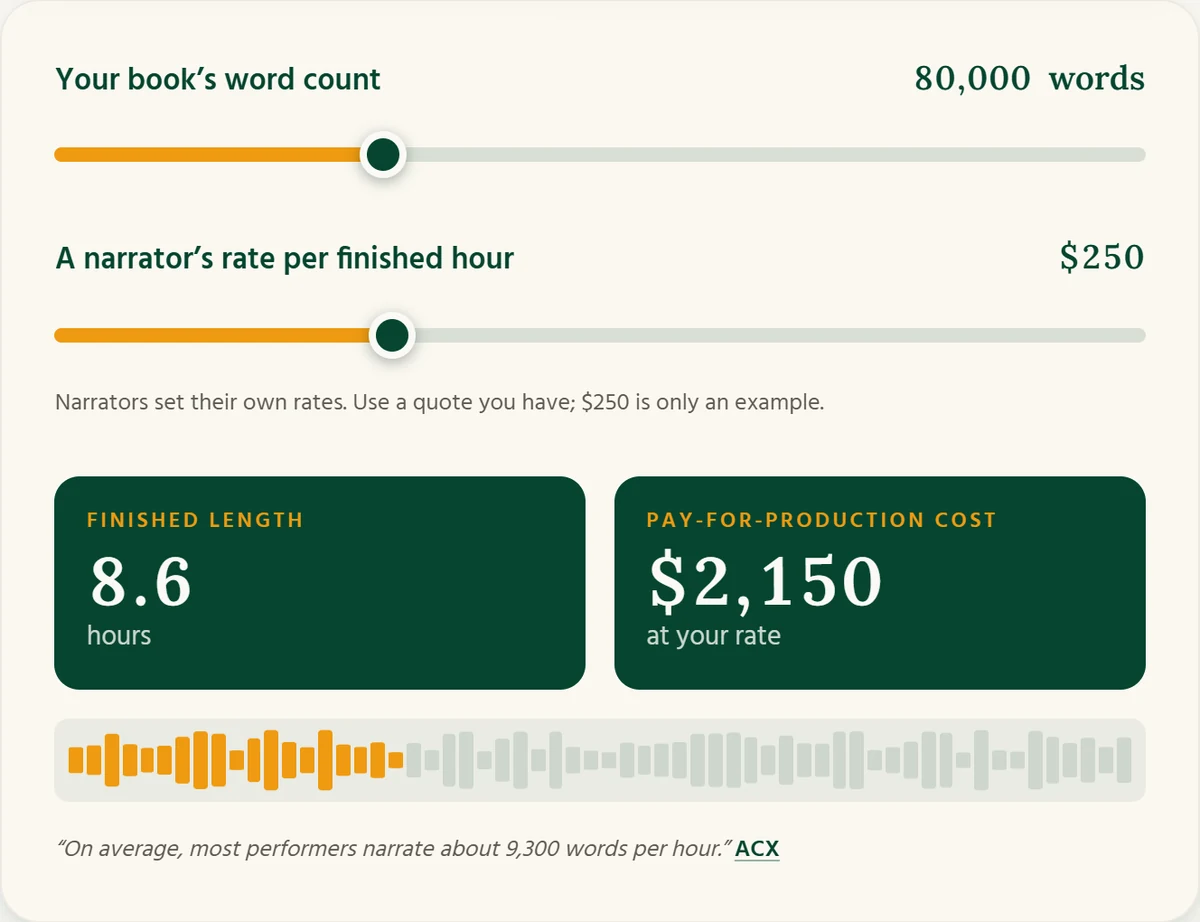
- An 80,000-word book: 8.6 hours × $250 = $2,150.
Replace $250 with your quotes, and you have your real cost.
What changes a narrator's quote
Since you'll be comparing quotes, it helps to know what goes into them:
- Experience and demand. Narrators with long track records and full calendars charge more.
- The book's demands. Many characters, accents, other languages, or dense technical vocabulary take more preparation and more studio time per finished hour.
- What the quote includes. Ask whether the rate covers editing, proofing against your manuscript, and mastering to ACX's technical requirements, or whether those are separate.
- Retakes. Ask how corrections are handled once you've listened to the chapters.
Compare quotes on what they include, not just the number.
Finished-hour pricing also works in your favor. Because the fee is "based on the length of the finished audiobook," you pay for the length of the final book, not for the hours spent recording it. A narrator who needs three takes of a difficult chapter is spending their own time, not adding to your bill. That makes quotes easy to compare: the same book, at the same length, priced per finished hour.
Step 3: Choose how to pay
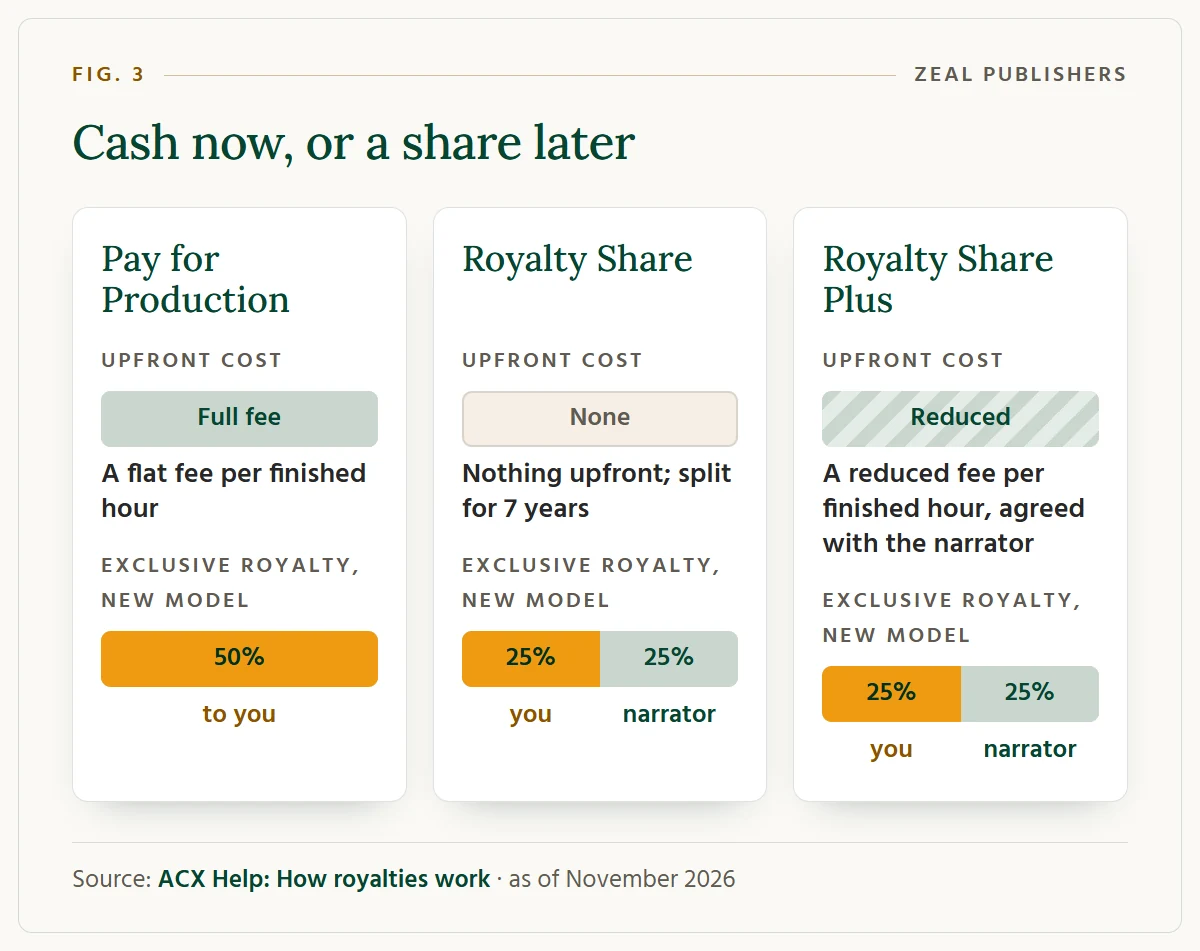
ACX offers three deals with a narrator (ACX calls them producers), and they spread the cost very differently. Source for all three: ACX Help: How royalties work, as of November 2026.
Pay for Production. You pay the flat fee per finished hour, once, and keep the whole royalty. On Audible's new royalty model, that's 50% with exclusive distribution or 30% with non-exclusive. This is the deal with an upfront cost, and the one where you keep everything afterward.
Royalty Share. "With a Royalty Share deal, producers forgo upfront payment in exchange for splitting the audiobook's net royalties with the rights holder." On the new model, you take 25% and the narrator takes 25%, for seven years, and distribution must be exclusive. Your upfront cost is nothing; your ongoing cost is half of every royalty.
Royalty Share Plus. This "combines a reduced upfront per-finished-hour payment from the rights holder, with the Royalty Share model." You pay a smaller fee per hour and still split the royalties, 25% and 25%, with exclusive distribution.
Narrators choose Royalty Share projects carefully, because they're paid only if the book sells. A book with a track record of sales, or an author with an audience, will find it easier to attract a Royalty Share narrator than a debut.
The right choice comes down to cash now against a share later. If you can pay the quote and you expect the audiobook to sell for years, Pay for Production keeps every point of the royalty. If you can't, or you'd rather test audio first, Royalty Share removes the upfront cost entirely.
What else goes into the cost
Narration is the biggest line, but a finished audiobook involves more:
- Editing and proofing. The raw recording is edited for pace and mistakes, and checked against the manuscript so every word matches the book.
- Mastering. The files have to meet ACX's audio submission requirements before they'll be accepted. See ACX's audio submission requirements for the current specifications.
- Your own time. You'll listen to every chapter and approve or request corrections. On a nine-hour book, that's at least nine hours of listening.
- A human voice. ACX's requirements state: "Your submitted audiobook must be narrated by a human unless otherwise authorized." Synthetic narration isn't a way to cut ACX costs.
Before you accept a quote, confirm which of these it covers.
Five ways to keep the cost down
None of these involve cutting corners on the narration itself:
- Edit before you record. Every word costs narration time, and changes after recording cost retakes. Record only the final, proofread text.
- Tighten the manuscript. A leaner book is a shorter audiobook. Cutting 9,300 words saves about one finished hour of narration.
- Choose the narrator on their sample, not their rate alone. A narrator whose natural voice fits the book needs fewer retakes and less direction.
- Send a pronunciation guide. List every name, place and technical term with how to say it. It saves corrections later, which saves studio time.
- Consider Royalty Share Plus. If the full fee is out of reach but you'd rather not give up half the royalties for nothing upfront, a reduced fee plus a split is a middle path, if a narrator agrees to it.
What Audible's 2026 royalty changes mean for cost
Audible's new royalty model changes the other side of the ledger. From May 26, 2026, ACX pays 50% for exclusive and 30% for non-exclusive distribution, up from 40% and 25%, and membership royalties are worked out from what ACX calls Member Value. ACX also says: "By end of year, Audible's legacy royalty model will be discontinued." Source: ACX Help: Audible's New Royalty Model.
Three consequences for the cost decision:
- Pay for Production benefits most. You keep the whole new rate, so the higher rates reach you in full.
- Kindle+ needs Pay for Production. KDP lists four conditions for an ACX audiobook in Kindle+, including a Pay-for-Production deal, exclusive distribution and an ebook in KDP Select. A Royalty Share audiobook doesn't qualify. (If your ebook isn't published yet, our guide to publishing an ebook covers the steps.)
- Existing audiobooks need action. If you already have a title on the legacy model, enroll it in the new model before the end of 2026.
Our guide to Audible's new royalty model covers the rates, the enrollment steps and Kindle+ in full.
The free route: KDP's Virtual Voice
KDP runs a separate program, Virtual Voice, that turns a KDP ebook into an AI-narrated audiobook at no cost. It's "an invite-only beta for eligible KDP eBooks," it pays 40% of sales, and it isn't available while the book already has an Audible audiobook. KDP asks beta participants to keep the details confidential, so we stop at the basics. Source: KDP Help: Audiobooks with virtual voice (beta).
If your book has been invited, the option appears on your KDP Bookshelf. If it hasn't, a human narrator on ACX is the route. If you're not sure which route suits your book, book a free 15-minute call and we'll go through it with you.
Is an audiobook worth the cost?
Nobody can tell you what an audiobook will earn, including us: ACX's membership royalties depend on Member Value, and there's no fixed amount per listen. So rather than a forecast, run your book through three questions.
- Is the book already selling? If the ebook and print editions sell steadily, an audiobook adds a format for a proven audience rather than testing an unproven one.
- Does the book work by ear? Narrative books, from novels to memoirs, translate naturally to audio. Books that rely on charts, recipes or illustrations need more thought, because the listener can't see them.
- Is the book doing a job for your work? If you're using it to build authority, an audiobook reaches people who listen while they drive, travel or exercise, and who might never open the print edition.
If two or more of these are true, an audiobook is usually worth pricing out properly. If none are true yet, it can make sense to build the print and ebook sales first and come back to audio later.
How we handle audiobook production
Our audiobook production service handles professional narration with hand-picked narrators, studio mastering that meets retailer specifications, and distribution to Audible, Apple Books and Spotify. Casting, recording, editing and upload are done for you, and you keep all rights and royalties. We quote audiobook production per project, by length, and a finished audiobook typically takes us four to eight weeks.
We don't push one deal by default. We'll tell you plainly whether Pay for Production or Royalty Share makes more sense for your book, based on its length, its sales and where your listeners are.
Work out your audiobook's cost in two minutes
The Audiobook Cost & Path Planner does every step above. Slide in your word count and it shows the finished hours; enter a narrator's rate and it shows the Pay-for-Production cost. Then six quick questions mark each of the five paths (Pay for Production exclusive or non-exclusive, Royalty Share, Royalty Share Plus and Virtual Voice) as a fit or not for your book.
Frequently asked questions
How much does it cost to produce an audiobook?
On ACX's Pay for Production deal, the cost is the finished length times the narrator's rate per finished hour. Divide your word count by 9,300 for the hours. ACX publishes no typical rate, because narrators set their own, so get two or three quotes. Royalty Share has no upfront cost but splits the royalties for seven years.
How long will my audiobook be?
ACX says most narrators record about 9,300 words per finished hour, so divide your word count by 9,300. A 60,000-word book comes to about 6.5 hours, and an 80,000-word book to about 8.6 hours.
What's the difference between Pay for Production and Royalty Share?
With Pay for Production, you pay the narrator a flat fee per finished hour upfront and keep the whole royalty. With Royalty Share, you pay nothing upfront and split the royalties with the narrator, 25% each on Audible's new model, for seven years, with exclusive distribution.
Can I distribute my audiobook outside Audible?
Yes, with non-exclusive distribution on a Pay-for-Production deal, which pays 30% on the new model. Royalty Share and Royalty Share Plus both require exclusive distribution.
How long does audiobook production take?
It depends on the book's length and the narrator's schedule. When we produce an audiobook, a finished audiobook typically takes four to eight weeks.
How Zeal helps authors
- Self-Publishing
- Ghostwriting
- Book Editing
- Cover Design
- Audiobook Production
- Book Marketing
- Memoir Writing
- Costs & Answers
- Free AI Tools
Publishing by book type
Ready to make your book real?
We write, publish & market it for you. You keep 100% of your rights.
Talk to a Publisher →or call +1 (609) 493-4557 · Free author tools · Authors Circle · All pages